Showing posts with label memory. Show all posts

Friday, May 27, 2011

Confederates in Harvard's Memorial Hall

via

With the advent of the sesquicentennial, there has been a surge of interest in all things related to the Civil War. At Harvard, this has taken the form of intensified debates over the inclusion of Harvard's Confederate dead in Memorial Hall.

Memorial Hall via Wikipedia

Harvard's Memorial Hall was built in the 1870s as a monument to Harvard's Union war dead. It is a huge, gothic building that houses Annenberg Dining Hall, Sanders Theatre, and a memorial corridor lined with marble plaques that bear the names of 136 Harvard graduates who died while serving with the Union army. The plaque in the center of the transept declares,
This hall commemorates the patriotism of the graduates and student of this university who served in the Army and Navy of the United States during the war for the preservation of the Union and upon these tablets are inscribed the names of those among them who died in that service.


The controversy arises from the fact that the 71 Harvard graduates who died in the Confederate armed forces are not included in this memorial. When the cornerstone for the building was laid (1870), the prevailing sentiment was toward honoring only those soldiers who had fought against treason. During the reconstruction era, Cambridge was still proud to characterize the war as a sacred struggle over both union and slavery, as demonstrated in the sphinx monument at Mount Auburn Cemetery (1872), which bears the text,
AMERICAN UNION PRESERVED
AFRICAN SLAVERY DESTROYED
BY THE UPRISING OF A GREAT PEOPLE
BY THE BLOOD OF FALLEN HEROES

Yet, the reconciliationist narrative came to Cambridge as surely as it swept over the rest of the nation. By the time the 50-year celebrations rolled around, there were active efforts to include the names of Harvard's Confederate dead at Memorial Hall. Monuments erected at Yale and Princeton during this era jumbled the names of Union and Confederate dead and honored all as patriots.

In the past year, the campaign to include the Confederate dead in Memorial Hall has ramped up again. Many pro-memorialization advocates have latched onto the fact that Memorial Church (a different building on campus, built in 1932 to commemorate the WWI dead) lists the names of several Harvard men who died serving in the German army in WWI and one Divinity School graduate who died in WWII. Last fall, the Harvard Crimson ran a long article about the differences between the Memorial Hall and Memorial Church commemoration philosophies, in which it quoted Prof. Alan Dershowitz as saying,
The University needs to adopt a policy one way or the other. The current inconsistent standard is unacceptable, and it’s particularly unfortunate that the exception seems to be for a member of the Nazi army, one of the darkest regimes in human history, and a regime with which Harvard had too cozy a relationship.
While I tend to think that Prof. Dershowitz would probably rather see the deletion of German soldiers from Memorial Church than the addition of Confederates to Memorial Hall, others have come to the opposite conclusion. The Harvard Confederate Memorial Initiative is a small, but vocal organization dedicated to advocating for a Confederate memorial at Harvard. You can view their intro video here. Their cause has been getting some attention, not just from the Crimson, but from conservative media outlets like World Net Daily. Last summer, a WND reporter confronted White House press secretary Robert Gibbs over the Memorial Hall issue — Gibbs had no comment. The HCMI also has a Facebook petition (currently rather pathetic at about 130 "likes"). Executive Director Roger McCredie told the Crimson that the HCMI's goal is to correct the historical narrative of "South equal bad. North equal good":
If you want to talk slavery, we can talk slavery all day long and about how no one’s hands are clean from it—including the Fanueil family and the Brown family, both of whom made fortunes on the slave trade. This extremely skewed view of history and of historical perspective has become pandemic—it does not infect merely Harvard; it infects the entire educated and cultural edifice of the United States these days.
Now, I know Mr. McCredie has a particular political agenda to advance, but this sort of thing is rage-inducing. He seems to be confusing Harvard with a mediocre elementary school circa 1990. The Harvard curriculum is hardly trying to cover up Northern complicity in American slavery with courses like Sven Beckert's "Harvard and Slavery" or faculty research like Jill Lepore's New York Burning or events like last month's joint conference with Brown, which was called "Slavery's Capitalism: A New History of American Economic Development" and focused on slavery's role in national economic development after the Revolution. When someone claims that academic historians are ignoring or trying to cover up Northern slavery, I know that I can safely disregard everything else in his/her manifesto because he/she clearly has no grasp of what academic historians do. Northern slavery is one of the hottest things going in Early American history at the moment. People who pretend otherwise are willfully ignorant in service of their neo-Confederate politics.

Yet, admittedly, academic historians are notoriously awful about getting the word out about our work. Part of that is our fault (we generally for one another rather than for a wide audience and punish colleagues who try to engage with the public), part is the fault of the structure of history education at the k-12 level (holiday history controlled by politicized state committees and useless AP-driven fact cram later on), part is the fault of public figures who appeal to history as a cover for their own biases (see the entire Scalia oeuvre), and part is the fault of an incurious general public that can't be bothered to read anything more challenging than a David McCullough biography. As an historian with a commitment to public history, I think it would be a great idea to do some public outreach regarding Harvard's role in American slavery and its considerable ties to the Confederacy.

Therefore, I propose the following exhibit:

Remembrance

In the transept of Memorial Hall, two rows of rectangular display pedestals will stand along the East and West walls, each directly under a memorial panel and mirroring the panel in shape and size, though tipped at a slight angle so that visitors can view the contents easily. Each pedestal will display an object or text relating to Harvard's multifaceted role in creating, sustaining, and challenging American slavery and the war that ended it. A final pedestal will stand at the North end of the transept, under the stained glass window, bearing the names of the 71 Harvard students and alumni who gave their lives in support of the Confederacy and its cause — not in violation of their position as Harvard men, but in fulfillment of it.

Examples of objects that would go into these cases:
  • J.T. Zealy / Louis Agassiz Daguerreotypes:
    • In 1850, Harvard's most celebrated naturalist, Louis Agassiz, traveled to South Carolina, where he commissioned a series of photographs of African-born slaves and first-generation African-Americans in an attempt to gather evidence about racial types. Agassiz believed that various races were created separately, and his use of scientific methods, including these photographs, lent his ideas intellectual weight in antebellum America. The daguerreotypes — many of them depicting their subjects nude, in the poses now familiar to us from mug shots — are held by Harvard's Peabody Museum. They are not on display, partly because they are fragile and partly because they are ghastly. For more information, see Molly Rogers' Delia's Tears: Race, Science and Photography in 19th-Century America. This book reprints all of the images in full, something I would not do here, even if I had permission.
  • Portrait of Thomas Wentworth Higginson by Frank Weston Benton (1893)
    • Higginson, a fiery abolitionist who contributed openly to John Brown's cause, was a member of the class of 1841. He was a true radical and found that the reforms brought about by the Civil War fell far short of his hopes for racial justice. In 1904, he gave a Decoration Day speech in Sanders Theatre in which he suggested that Confederates might be included in the tablets in the transept. While some historians (David Blight) have argued that Higginson represents the erasure of abolitionism from Civil War memory, others (W. Scott Poole) argue that Higginson's remarks in 1904 "speak to his own disillusion about the possibilities of nationalism and his doubts about whether or not it could serve as a force for racial justice." Higginson's portrait (along with various quotations) would provide an unparalleled example of the complexity of Harvard's relationships with abolitionism and Civil War memory.
  • Samples of "Negro Cloth" from Rhode Island 1839-1850 from Baker Library (Harvard Business School)
    •  Many Harvard alumni and donors (ex: Francis Cabot Lowell, class of 1793) were industrialists who turned slave-grown Southern cotton into cheap cloth. Some of this material, like the samples above, were manufactured in order to be sent back to Southern plantations to clothe those same slaves. Several cases in this exhibit would be devoted to the Harvard/factory/plantation nexus.
Other cases would showcase other items related to Harvard's historical support of and entanglement with slavery — receipts for gifts from slaveowning or slave-industry alumni, a replica of the gravestone dedicated to Cecily (d. 1713, 13-year-old slave to William Brattle, class of 1680), a fragment of brick from an 18th-century college building built using slave labor, etc. An exhibit like this would probably be the fruit of research conducted in undergraduate seminars (like Prof. Beckert's) and by professors and community members as part of a commission similar to Brown's Committee on Slavery and Justice. Its catalog would probably go on to form part of a larger report by the commission laying bare Harvard's complicity. I know that a report from a steering committee doesn't sound like a very friendly way to get the word out, but there was plenty of interest in Brown's report, and Harvard's would make a bigger splash. People might not read the report, but they would read the NYT article about the report.

In this way, Harvard could engage in meaningful reflection on its institutional history. I think that a public exhibit in Memorial Hall would be a powerful way to write Harvard's Confederate dead back into its story, not with celebration, but with conscience. The point would be to bring context to the names already on the walls in the transept. They were the memorial that Harvard needed in 1870, but we need something more in 2011.

Roger McCredie and others who call for the names of Harvard's Confederate dead to be added to the rolls of honor in Memorial Hall argue that Harvard should acknowledge its role in the development and maintenance of American slavery. I agree. But simply adding the names of Harvard's Confederates would not just acknowledge that role — it would perpetuate it. If Harvard were to take such a bold and public step in favor of a reconciliationist narrative that argues that the Civil War was about personal valor and sacrifice, rather than a struggle over treason in defense of slavery, the institution will have lent its considerable cultural capital to the mythology of the Lost Cause. It will have arrayed what arms it has on the side of a white supremacist, anti-intellectual movement that is stuck in the mindset of the 50th anniversary while the rest of the nation observes the 150th. Luckily, I think there is very little chance that this will happen, particularly under the administration of President Faust, who is, after all, a scholar of the Civil War with a particular interest in memorialization. If the names of Harvard's Confederate dead are added to Memorial Hall — and I hope they are — they must be part of an effort to confront Harvard's institutional complicity, not an attempt to prolong it.

Monday, August 9, 2010

Six Percent Revisited

Andy Hall, guest-blogging for Ta-Nehisi Coates, takes on the myth of the 6% in a new post, "Small Truth Papering Over a Big Lie."

In addition to Joseph T. Glatthaar's study of the Army of Northern Virginia, which Hall mentions, I recommend the following books to anyone who is interested in the question of white Southerners' investment in slavery:
I'm glad to see this issue getting some attention on a blog with such a large popular readership.

Thursday, April 15, 2010

Samuel Sewall's "Connecticut Stone Post"

I'm reading more of Samuel Sewall's diary today and came across this intriguing entry:
This day, [September] 16 [1721] I set up my Connecticut stone post in Elm pasture, in Remembrance of my loving Wife Mrs. Hannah Sewall.
I don't know what a "Connecticut stone post" is, but since it seems to be a material object dedicated to the memory of the dead, I am interested in finding out.

Tuesday, March 2, 2010

African Burial Ground National Monument Opens in New York

On Saturday, the visitor's center at the African Burial Ground National Monument opened in Lower Manhattan. The museum and memorial mark the location of a graveyard used by New York's enslaved and free black communities between 1690 and 1790. In the 1990s, construction uncovered more than 400 bodies, which have been catalogued, studied, and reburied beneath the new monument.

The New York Times has a lengthy review of the new museum. The author, Edward Rothstein, is a bit skeptical of some of the exhibits' politics and questions whether the conclusions on display are supported by the evidence. I haven't visited yet, so I can't really speak to his specific criticisms, but I know that it can be very tempting to over-interpret evidence in graveyards. Still, I wish that Rothstein had interviewed some of the attendees about what the memorial meant to them. As he notes in the first sentence of his review, "Cemeteries are at least as much for the living as the dead." That's very true, and I do not necessarily think that that is a bad thing. It is the main contention of my dissertation that colonial American graveyards were political spaces from the first, so it is unsurprising that they still are today.

I'm not a great lover of New York (too big for me), but I'm excited about visiting this memorial. Wouldn't it be great if we could get a visitor's center for God's Little Acre in Newport?

Friday, October 9, 2009

The Shoemaker and the Tea Party


The undergrads in my research seminar are reading Alfred F. Young's The Shoemaker and the Teaparty: Memory and the American Revolution.

I could go on an on about how this is a lovely little book for introducing the subject of historical memory to undergraduates. I could tell you that Young's skillful blending of biography and argument in the first half is a great model for writers embarking on their first research projects. I could rhapsodize at length about the usefulness of this book for exploring the process of nation-making between 1790 and 1830.

Instead, I will chuckle and observe that the titular shoemaker, George Robert Twelves Hewes, had fifteen children. He named the 11th "Eleven Hewes" and the 15th "George Robert Twelves Fifteen Hewes" (called "Fifteen" in everyday situations).

Also, this book, at 207 pages plus an 11-page preface, earns a VPI Grad Student Seal of Approval.

Thursday, August 13, 2009

Dear Broadsheet,

For most of recorded human history, women have given birth surrounded by neighbors, friends, mothers, sisters, in-laws, etc.

Communal childbirth is not a "trendlet." In fact, it is more in line with historical norms than the 20th-century idea that birth should be "private." The major difference between modern communal childbirth and historical communal childbirth is that modern fathers are usually expected to participate (though other male relatives often aren't).

Anyway, congrats to Sara and Ev — don't let the historical amnesiacs who rule the Mommy Wars get you down.

Friday, July 17, 2009

Mementos at Arlington

I've been reading Salon's series on "Grave Offenses" at Arlington National Cemetery and I have to say, I'm pretty underwhelmed. Despite the author's outraged tone, there seems to be little cause for the sensational titles. Coming in the wake of the Burr Oak disaster, I think it's somewhat irresponsible of Salon to sensationalize this series which, as far as I can tell, has uncovered no malicious intent or actual wrongdoing.

The first installment made a few serious (though unsubstantiated) accusations — some bodies are not buried beneath the correct headstones — that, if true, are truly troubling. Other complaints — the computer database project is taking longer than expected — are par for the course and hardly outrageous. The boss sounds like a jerk, and, should the investigation find that he did mistreat his employees, he should be punished. That said, Salon presents no evidence to back up its most sensational claims about the actual treatment of bodies at Arlington.

Today's follow-up piece examined the treatment of mementos left at veterans' graves. The author, Mark Benjamin, writes in high dudgeon about personal artifacts being "trashed" at Arlington, rather than catalogued and preserved as they are at the Vietnam Veterans Memorial:
The sun was out after several days of rain . . . Left out in the rain to rot were crayon drawings by children who had lost a parent, photographs of soldiers with their babies, painted portraits and thank-you notes from grade-school kids to fallen soldiers they had never known. Colors of artworks ran together. Photos were blurred and wilted. Poems and letters were illegible wads of wet paper. A worker in a brown uniform wandered among the graves, blasting the headstones with a power washer without regard to what was left of the mementos -- or the obviously uncomfortable mourners looking on. Some items got further soaked. The worker blasted others across the grass. Many of them would end up in a black trash bin in the cemetery's service area.
Benjamin goes on to interview family members who are "distraught" to discover that their grave offerings are destroyed after they are collected during regular cemetery maintenance. He is shocked at the paltry collection of artifacts preserved by cemetery staff — medals, uniforms, children's drawings — which pales in comparison to the vast collection of the Vietnam Veterans Memorial. "What war stories had been lost forever? What words from a father to a son or wife to a husband were sitting in some landfill? What meaningful personal artifacts had been relegated to the Arlington trash bin?"

Benjamin has two major objections: the artifacts are treated disrespectfully and they are not being preserved for posterity. The first seems quite overblown — he admits that he visited after several days of heavy rain and the "disrespect" he witnesses seems to consist mainly of soggy letters that have blown about. Does he want Arlington to build a dome? And yes, items left at graves are often removed and discarded in order to keep the cemetery uncluttered. I don't think that this comes as a surprise to anyone. The word "trashed" seems harsh, but I haven't read anything that suggests to me that the Arlington staff has treated grave offerings with callous disregard.

The second complaint is more interesting to me. As an historian, I'd love to see every artifact ever created preserved, but that's a very selfish impulse.

I started out on Benjamin's side, but his over-the-top indignation lost me by the end of the article. His major complaint is that Arlington's collection policies are not the same as the Vietnam Veterans Memorial's. Of course they aren't. The Vietnam Veterans Memorial's policy of collecting, cataloguing, and preserving every photograph, flower, and teddy bear left by visitors is extraordinary, not routine. The collection is vast and growing and is already a valuable resource for scholars.

Benjamin laments that no similar collection exists at Arlington, but that strikes me as an unreasonable standard. No cemetery saves all of the grave offerings — how could it? Set aside the logistics of collecting artifacts from Arlington's 600+ acres vs. the VVM's 500 linear feet, set aside the logistics of cataloging and preserving all of those tons of artifacts, set aside the fact that Arlington has never made a commitment to building a collection (in fact, they ask people not to leave items other than flowers). Should Arlington save the offerings? I'm not so sure.

What is the function of a grave offering? Is it meant for the historian's eye? Or does the historian commit an act of violence merely by gazing? Does it do its work in an archive? Or is it the exchange between the bereaved and the beloved that matters?

As historians, we want to know everything, read everything, and speak for others. We want to dig below the surface, expose everything to the light, claim understanding. It is very hard for us to accept the sacredness of silence and the utility of decay. I would like nothing better than to dig up every body in the slave section of the Newport Common Burying Ground and count the beads, examine the bones, analyze the offerings. What stories I could tell! But I have accepted that those offerings are not for me. It's why I don't support the idea that gravestones should be removed from cemeteries in order to preserve the art — decay is part of the life of that object and it can never mean the same thing in a museum as it did on a hill overlooking the harbor.

Why should we save a letter left on a soldier's grave? Why is it disrespectful to let it dissolve in the rain, soak into the soil, or fly away in the wind?

Benjamin's article reminded me of a seminar I attended when I was in high school at a local historical society. A preservationist from the SPNEA was speaking about preservation techniques for textiles and furniture to an audience of amateurs with attics full of family relics. The preservationist's specialty was quilts, and her eyes widened with wonder when one elderly woman brought forward an ancient quilt that had passed from generation to generation in her family. It was a beautiful quilt — intricate, colorful, and very, very old by quilt standards. When the woman started talking about how their family uses the quilt for their annual family picnic, the preservationist's eyes just about fell out of her head. There was a lot of stammering about wrapping it mylar and NEVER EVER taking outside ever again. The woman looked at the preservationist like she was crazy and said something along the lines of, "everyone in my family for eight generations has sat on this quilt, and you'd better believe it's going to see nine and ten."

What is the value of a quilt? Should it be protected from moths and studied by professors? Or should it decay with use by a family that values it for what it means to them, not for what it tells us about the social and cultural history of quilting?

I'm a professional scholar of material culture. I love an old quilt. I love an old letter. If I had a box full of grave offerings from the 18th century, I'd faint with delight. But I'm not troubled by the treatment of artifacts at Arlington as described in the Salon article. The artifacts are not preserved, but they seem not to be mistreated. What's wrong with that?

Monday, April 6, 2009

Seduction Novels in the Graveyard

In the new issue of Common-Place, Lisa Gordis writes about the modern audiences that appreciate early American books. At the end of her article, Gordis discusses a visit to the "Charlotte Temple" gravesite in New York's Trinity Churchyard. Of course, Charlotte Temple is a fictional character, so she isn't really buried under the stone that bears her name, but somebody (probably) is. During the 19th century, the gravesite attracted a steady stream of devoted pilgrims.

There is a similar monument in Peabody, MA dedicated to Elizabeth Whitman, whose tragic death inspired Hannah Webster Foster to write The Coquette. As far as I know, it attracts very few visitors.

Tuesday, March 31, 2009

The Suffering of Amos Humiston

The New York Times is running a five-part feature on Sgt. Amos Humiston, a New York soldier who was killed at Gettysburg. Humiston's remains were identified after several newspapers circulated details about an ambrotype of his three young children that was found among his possessions.

Errol Morris is investigating the Humiston case with an eye to both history and memory:
There were two separate searches more than a century apart, an initial search to identify the fallen soldier, and then a subsequent search to discover something about the man. There is also a series of implicit questions. The first question is: What is his name? The second question: Who is he? Tell me something about Amos Humiston. And then, there is a third question: “Who is he to us? What does he mean to us?” 
I'm especially interested in that third question. I wonder if Morris will recognize the Humiston monument as part of a reconciliationist narrative in the monumental landscape at Gettysburg.

Monday, July 14, 2008

The Saddest Grave in Menotomy

The Old Menotomy Burying Ground in Arlington, MA is not my favorite graveyard around here. It is very well maintained and manicured, which is fine, but it's not as much fun as going into the overgrown, neglected burying grounds. It's the difference between going into a junk shop and going into an antique store where everything is labeled and locked away in cases. You'll see some great stuff in the glass cases, but it's more fun to go into the junk shop and there's a better chance you'll find a great deal. That said, Menotomy isn't a bad little graveyard.

I try not to get too caught up in the tragedies behind gravestones, preferring to focus on their value as material objects and concrete expressions of cultural values. Each stone represents a terrible loss for someone, so there isn't much point in ascribing special value to some over others because they are especially tragic. Still, every once in a while, a stone tells such a sad story that I can't help but be drawn to it, even if it isn't stylistically or linguistically interesting.

Which brings me to the saddest grave in Menotomy. Along the back wall of the burying ground, there is a small British flag stuck into the ground, marking the approximate gravesite of some of the 40 British Regulars who were killed at the Battle of Menotomy. A small, laminated card on the front reads,
In Memory
of the British Soldiers
who gave their lives
in the service of
their King and Country
April 19, 1775
Unnamed
and seldom remembered,
they have lain here over 230 years.
Rest in Peace.
I don't know who put up this little memorial, but I found it very touching. It stands very near the grand obelisk dedicated to the slain Minute Men and the juxtaposition is stark. There's a little stone dedicated to an unnamed Regular in the Lexington graveyard that didn't strike me as too sad, so I think that maybe the lack of a stone is what makes this ephemeral tribute particularly pathetic and poignant.

I'll join Lori in remembering the American dead, but would humbly ask that we also include a thought for these unnamed dead.

Monday, June 9, 2008

John Boyle's Diary and the NEHGR

For the last few weeks, I have been toying with the idea of working with the John Boyle diary in some serious way. It's not the most compelling project I can think of, but it is an important source, and I think that annotating and publishing it would be a great help to many researchers.

This morning, I went to Widener and copied the transcription that appeared in the 1930-1931 volumes of the New England Historical and Genealogical Register (NEHGR). The transcription is preceded by a short introduction, which contains a brief biography and genealogy of John Boyle, as well as the following note:
In this article, the REGISTER presents a verbatim copy of John Boyle's "Journal," only a few passages — chiefly verses of no historical or genealogical importance or certain entries hardly suitable for publication — being omitted.
As you might imagine, the entries that discuss rape and genital mutilation that I presented here are deemed "hardly suitable for publication." I have found 12 entries that have been wholly or partially redacted, including a tantalizing entry discussing a Sons of Liberty dinner that ends enigmatically:
After an elegant Repast a Number of Patriotic Toasts were drank . . .
I'll be in the archives this afternoon and will report back on the unspeakable debauchery.

Tuesday, April 22, 2008

Confederate Commemoration and the Lost Cause

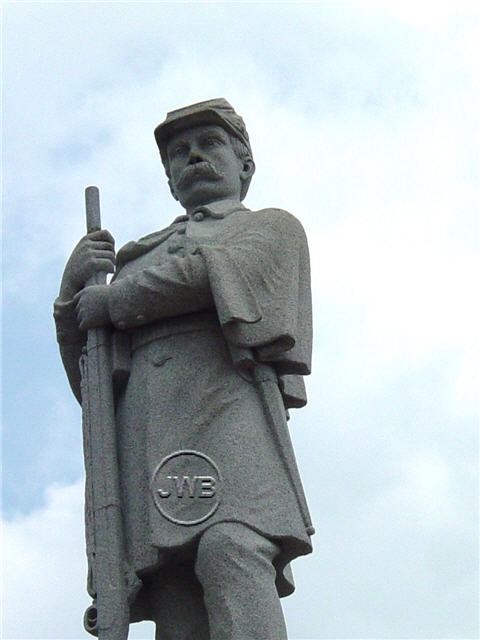
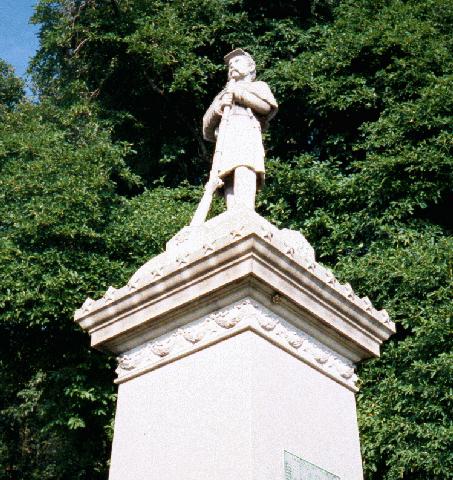
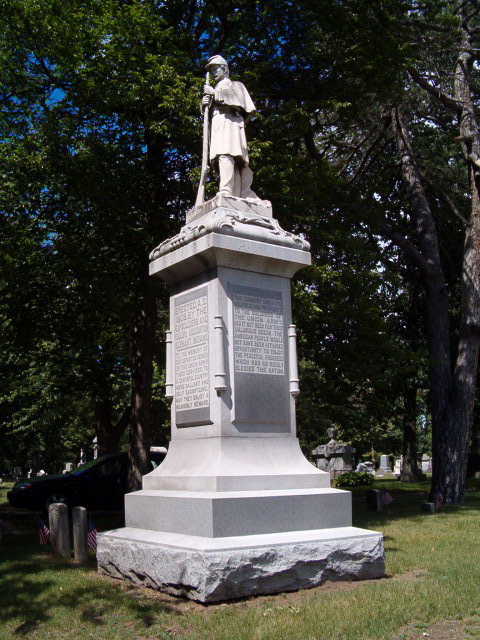
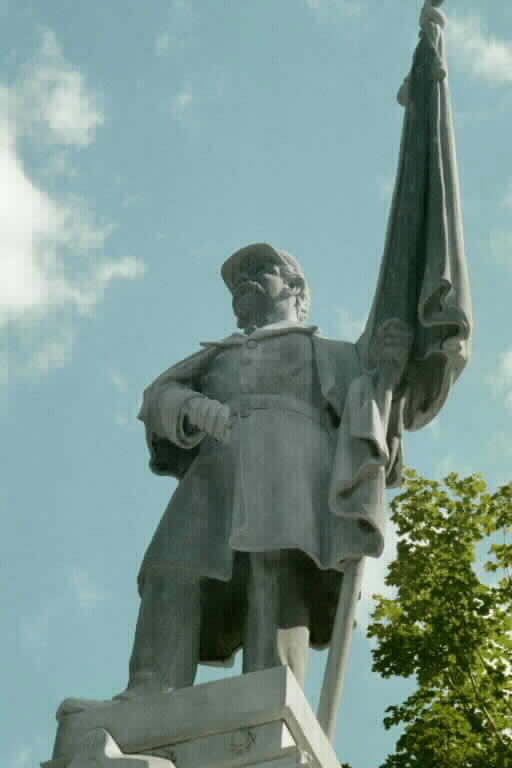
Yesterday, Professor O'Donovan spoke on the subject of memorialization in the decades after the Civil War with particular attention to public monuments in public places. Anyone who has driven through a little town in Northeast will recognize the archetypical Civil War monument: a young, white, lone infantryman with an immaculate uniform and a rifle (and sometimes a flag) stands sentinel at the top of an obelisk. These monuments commemorate a particular version of the war — one in which vigorous Anglo-Americans fought for high ideals but, according to the monuments, did not suffer, die, have legs amputated. There are no slaves, no African-American soldiers, no hint of the reasons behind the war. Instead, the town square monuments celebrate an ideal American who defended an abstract concept of America at a time when immigrants, ex-slaves, and union workers were threatening middle-class visions of national unity.

After class, I started wondering what messages monuments send in places that have both Union and Confederate monuments, such as the Gettysburg National Battlefield. At Gettysburg, most of the monuments commemorating Union regiments were erected in the late 19th and early 20th centuries and many of those with sculptural soldiers follow the same patterns as town square monuments. A few of the Union monuments are more dynamic, interesting, or impressive, but they are generally pretty staid.

In contrast, the Confederate monuments are arresting, tragic, and glorious. This is partially a function of the periodization of these monuments: most Union monuments went up in the 1880s and 1890s and reflect the sculptural conventions of that time. Although the Virginia monument was erected in 1917 and the North Carolina monument was dedicated in 1929, most of the Confederate monuments have been erected since the 1960s. It's not just their modernity that makes these monuments more compelling. Let's take a look at some examples:

Louisiana (via):

Mississippi (via):


North Carolina (via):

Alabama (via):

The difference is incredible. The Confederates are struggling, striving, and even dying. In contrast to the remoteness of the Union monuments, the Confederate monuments evoke a visceral reaction. Who can behold the Mississippi monument without feeling sympathy for the barefoot, desperate, suffering men who are clearly fighting for their lives? Even though Gutzon Borglum designed the North Carolina monument in the 1920s, to modern eyes, it recalls the flag raising at Iwo Jima. These Confederates are eminently sympathetic. They are not traitors or slaveholders. They are noble, suffering men, and the contrast between them and their Union counterparts could not be more stark.

One interesting case is the Maryland memorial, which is supposed to commemorate both Union and Confederate soldiers. The two men on the Maryland monument are brothers - they aren't even armed! There is no better example of the racist narrative of Civil War commemoration than this: in this representation, there is no hint that the war might have been about slavery - it is merely a story of mutually brotherly struggle and reconciliation.
Maybe I'll get into the disgusting rhetoric of the dedication speeches another day.

Just one more thing: many Union monuments are located at the point of that regiment's farthest advance (i.e. Peach Orchard, Wheat Field). The Confederate monuments are arrayed along the battle line they occupied immediately prior to Pickett's Charge. At Gettysburg, the monumental landscape is permanently frozen just before the disastrous assault that spelled doom for Lee's hopes of invading the North. Discuss.