Wednesday, August 13, 2008
Answers for "18th-Century Connecticutian or Muppet?"
Click here to see the answers for yesterday's game.

Tuesday, August 12, 2008
18th-Century Connecticutian or Muppet?

1. Herbert Birdsfoot
2. Sherlock Doolittle
3. Hannah Hobby
4. Vincent Twice
5. Herman Bird
6. Orange Wedge
7. Alice Braithwaite Goodyshoes
8. Bathsheba Bird
9. Bathsheba Bugbee
10. Appleton Osgood
11. Lola Tuttle
12. Algernon Snerp
13. Noble Lyon
14. Nobel Price
15. Samuel Snively
16. Grover Partridge
17. Fanny Nesselrode
18. Comfort Hungerford
19. Christopher Clumsy
20. Forgetful Jones
21. Remember Baker
22. Abby Cadabby
23. More Bird
24. Polly Darton
25. Festus Canada

Monday, August 11, 2008
Amending Imported Stones
When I was in Maine, I noticed that many of the 18th-century graveyards were dominated by stones from the big Boston carvers, particularly the Fosters of Dorchester. This makes sense due to the close ties — social, economic, and political — between coastal Maine and Massachusetts. Besides the prevalence of Dorchester-carved slate, one of the most notable things about Maine gravestones is the vast number of epitaphs that emphasize the deceased's connections with Massachusetts.
In addition, the readily-available stone in southeastern Maine is crappy for making gravestones (the stones made of local stone are typically severely deteriorated and illegible), so it makes sense that anyone with enough money would send home to Boston for slate.
The quality of the lettering on these stones indicates that the epitaphs were carved by professionals in Boston. This raises an interesting question: how did they know what to carve? Unlike local carvers who might have known the deceased or his/her family, urban carvers serving a rural market must have received orders by letter (this is probably true of any of the larger carving workshops). I don't know who wrote those letters, but it seems that somewhere along the line, there was a failure of communication.
I say this because I've seen several slate gravestones in outlying communities on which an unskilled person has altered the dead person's name.
 The Joshua A. Hopkins stone (1815) in Wellfleet, MA, out near the tip of Cape Cod, is a good example of this pattern. The high-quality slate and elegance of the engraving suggest that this stone was carved near Boston and shipped across Massachusetts Bay (though I should note that I'm not 100% sure — the urn is fairly simple and could have been carved by a local). That far out on the cape, there's very little native stone worth carving. When the stone arrived, someone was obviously dissatisfied because the letterer left out Hopkins' middle initial. Since the rest of the stone is run-of-the-mill (not even a verse), it's possible that a friend of the Hopkins family ordered the stone while in Boston and didn't think to include personal details. Regardless of who ordered the stone, someone in Wellfleet was disappointed and did his or her best to correct the omission.
 The Abigail Grosvenor stone (1763) in Pomfret, CT has a similar correction. It's a Boston-area slate stone (probably from the Foster shop) with competent lettering, though, to be honest, it looks like they let a high-level apprentice do the lettering because it's not as crisp as it should be. If the original lettering looks a little rough, the prominent addition of "JUNR" looks like it was gouged out with a sharp stone. If the text had been carved by a local, it would make sense to have the same hand make the correction. Instead, a much less skilled carver hacked out the missing designation.
 Of course, a local carver could mess up name just as well as a carver who had to send his stone 100 miles. I'll put together a collection of name corrections and we'll see whether there are any differences between small-time carvers working in a local market and large operations serving distant communities.
In addition, the readily-available stone in southeastern Maine is crappy for making gravestones (the stones made of local stone are typically severely deteriorated and illegible), so it makes sense that anyone with enough money would send home to Boston for slate.
The quality of the lettering on these stones indicates that the epitaphs were carved by professionals in Boston. This raises an interesting question: how did they know what to carve? Unlike local carvers who might have known the deceased or his/her family, urban carvers serving a rural market must have received orders by letter (this is probably true of any of the larger carving workshops). I don't know who wrote those letters, but it seems that somewhere along the line, there was a failure of communication.
I say this because I've seen several slate gravestones in outlying communities on which an unskilled person has altered the dead person's name.
 The Joshua A. Hopkins stone (1815) in Wellfleet, MA, out near the tip of Cape Cod, is a good example of this pattern. The high-quality slate and elegance of the engraving suggest that this stone was carved near Boston and shipped across Massachusetts Bay (though I should note that I'm not 100% sure — the urn is fairly simple and could have been carved by a local). That far out on the cape, there's very little native stone worth carving. When the stone arrived, someone was obviously dissatisfied because the letterer left out Hopkins' middle initial. Since the rest of the stone is run-of-the-mill (not even a verse), it's possible that a friend of the Hopkins family ordered the stone while in Boston and didn't think to include personal details. Regardless of who ordered the stone, someone in Wellfleet was disappointed and did his or her best to correct the omission.
 The Abigail Grosvenor stone (1763) in Pomfret, CT has a similar correction. It's a Boston-area slate stone (probably from the Foster shop) with competent lettering, though, to be honest, it looks like they let a high-level apprentice do the lettering because it's not as crisp as it should be. If the original lettering looks a little rough, the prominent addition of "JUNR" looks like it was gouged out with a sharp stone. If the text had been carved by a local, it would make sense to have the same hand make the correction. Instead, a much less skilled carver hacked out the missing designation.
Sunday, August 10, 2008
Soul by Soul
I'm back from Maine. It rained quite a lot, but I got to spend some time reading on the beach.
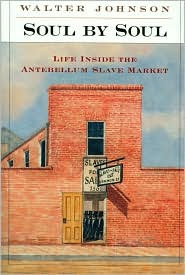 My first beach read was Walter Johnson's Soul by Soul: Life Inside the Antebellum Slave Market (1999). You might justifiably wonder whether I got any strange looks, but I was sitting next to my mom, who brought along a 3" binder full of photocopies of 19th-century letters so that she could do a little transcribing. At least mine was a paperback.
I've been trying to think of a satisfying way to describe Soul by Soul, but after 3 days of reflection, it still eludes me. I guess the best way to say it is that this is a tremendously useful book, but it's not a very good read.
Rather than a history of slave markets in general or of a particular historical moment, Johnson has written a book about how slaves, buyers, and sellers experienced the market, both empirically and imaginatively. It's not really a book about what happened so much as a book about how things happened.
I tend to like a little narrative with my history, so Johnson's style didn't appeal to me. Instead of telling stories and interpreting the actions and ideologies of the participants, Johnson writes in an endless series of introductory paragraphs: lots of sweeping statements backed up by brief sketches and quotations that sometimes seem dropped out of the sky. I think that his argument would have been more accessible if he had kicked off each chapter with a short, narrative example so that the reader could grab hold of some grounding specifics.
I don't mean to imply that Johnson's sources are insufficient support for his argument. In fact, I think he does a brilliant job interpreting his sources, especially when he is illuminating how slaveholders thought about themselves and performed their identities. But I do think that he could have done a better job of explaining his sources (slave narratives, Louisiana court records, and slaveowners' letters). I didn't really get a good sense for the bodies of evidence because Johnson presented such abbreviated excerpts from individual court cases and letters without really setting the stage. I'm not quite as paranoid as some of the Amazon reviewers, but I did think that his style was less persuasive than it could have been because so many of the quoted sources were presented without a lot of context.
The very qualities that make Soul by Soul an unsatisfying read make it delightfully useful. The writing is not overburdened with specific details of individual transactions, so there's no need to search around for the plainly-stated conclusions. Since Johnson does not shy away from sweeping statements of his arguments, he is unfailingly quotable.
Here's a rundown of the major points (this is mostly so I remember them for generals):
Chapter 1: The Chattel Principle:
Even when they were not in a physical slave market, enslaved people's lives were lived in the shadow of their monetary value. Although slaveowners tried to draw an imaginary boundary between the market and the everyday course of slavery, slaves lived in "perpetual dread" of being separated from their families, communities, and familiar work regimes on their master's whim. Slaves resisted being sold in various ways (running away, threatening to commit suicide, appealing to slaveholders' sense of obligation as patriarchs) and masters engaged in elaborate subterfuges in order to avoid resistance.
Key quote:
"At the heart of the slave market, then, there was a contradiction and a contest. The contradiction was this: the abstract value that under-wrote the southern economy could only be made material in human shape — frail, sentient, and resistant. And thus the contradiction was daily played out in a contest over meaning. Were slave sales, as so many slaveholders insisted, the unfortunate result of untimely deaths, unavoidable debts, unforseeable circumstances, and understandable punishments, or were they, as so many slaves felt, the natural, inevitable, and predictable result of a system that treated people as property?" (29)
Chapter 2: Between the Prices:
Although the chattel principle imagined enslaved people in terms of their potential prices, the reality of slaves' humanity was unavoidable. Slave traders used their assumptions about slaves' humanity to maximize their profits and minimize their risks. For example, a trader might hold out the promise of kindness toward a child in order to keep a parent from resisting or might rape a slave in order to humiliate and subdue her. At the same time, slaves formed new communities in the markets, allowing them to pass on information that could lead to various types of resistance.
Key quotes:
"The slave traders did not ignore or abolish the humanity of the people they categorized and compared and bought and sold. They used it. To protect themselves and their investment, the traders had to imagine the world from their slaves' perspective: to see geography and time and human connections and desire as their slaves did and to insinuate their surveillance and insert their discipline in every detail of the slaves' existence" (63).
"There was nothing automatic about the formation of a community of slaves in the trade — the slave coffles and pens, indeed, were shot through with animosity and suspicion; yet out of these contingent interactions could be fashioned connections that could sustain slaves emotionally and help them circulate important knowledge about the trade" (76).
Chapter 3: Making a World Out of Slaves:
White slaveowners fashioned their own identities out of their relationships with slaves and other slaveowners. For example, a slaveowner who wished to see himself as a benevolent patriarch might think of buying a slave as "rescuing" that person from the evils of the market. White men entered into full membership in Southern society by becoming slaveowners and set themselves up as good providers by buying people who could care for their children, free their wives from manual labor, and provide financial security for their families.
Key quotes:
"Built out of people who could be bought in the market, slaveholding households were advertisements for their masters, for their gentility and distinction, for the delicacy of their women, the tone of their lives, and the quality of their service" (101).
"They bought slaves to make themselves frugal, independent, socially acceptable, or even fully white; they acted in accordance with the necessities of their their business or the exigencies of their households; they covered the contingency of their own identities in the capacious promises of paternalism, buying on behalf of the bought; they obscured the dependency of their fantasies with the brutality of their mastery" (116).
Chapter 4: Turning People into Products:
In order to maximize their profits, slave traders had to appeal to buyers' fantasies. Accordingly, they invented new histories for the people they sold, often obscuring or misrepresenting illness, disability, and skills. Traders also devised categories for slaves based on age, sex, health, and skill set and dressed slaves alike so that they became interchangeable representatives of their categories onto whom buyers could project their expectations.
Key quote:
"The traders' daily business was to shape the real people they had in their hands to reflect the abstract market they had in their heads, and then to punctuate their categories of comparison with the value-producing practice of differentiation: the special clothes and spatial arrangement, the articulated human connections, the singular story" (133).
Chapter 5: Reading Bodies and Marking Race:
In the market, buyers tried to discover slaves' histories and potential by examining their bodies. In addition to assessing physical strength, buyers used physical characteristics such as skin color as manifestations of a slave's abilities (ex: dark skin = health, hardiness, resistance to disease; light skin = "delicacy," capacity for skilled work). Slaveowners' ability to "read" slaves' bodies reflected on their own competency — men who could interpret bodies gained reputations for their skill, while men who bought dying slaves might be ridiculed for their gullibility.
Key quote:
"The rituals of the slave pens taught the inexperienced how to read black bodies for their suitability for slavery, how to imagine blackness into meaning, how to see solutions to their own problems in the bodies of the slaves they saw in the market. Gazing, touching, stripping, and analyzing aloud, the buyers read slaves' bodies as if they were coded versions of their own imagined needs — age was longevity, dark skin immunity, a stout trunk stamina, firm muscles production, firm breasts fecundity, clear skin good character" (149).
Chapter 6: Acts of Sale:
In the end, buyers/slaveowners were dependent on the people they enslaved for information and performance that lived up to the masters' expectations. In the market, slaves could manipulate their words and actions to encourage an advantageous sale, avoid an unfavorable one, or persuade a master to return the slave and void the sale (legal in LA up to one year after purchase).
Key quotes:
"Slaves were the information brokers in the slave market" (176).
"But is buying on trial allowed slaveholders an opportunity to extend the slave market in time and space, it also gave slaves an opportunity to examine their buyers and choose whether to match or subvert their evident expectations" (182).
Chapter 7: Life in the Shadow of the Slave Market:
Once buyers brought slaves home from the market, they were perpetually disappointed because the "frailty or resistance" of the enslaved people themselves could never live up to the slaveowners' fantasies. Since slaveholders imagined that their slaves would respond in predictable ways to their beatings or entreaties, any discrepancy between expectations and performance was taken as evidence of the slaves' stupidity, laziness, or bad character. As much as slaves were dependent on the will of their owners, masters were dependent on the daily decisions of their slaves.
Key quote:
"Life in the shadow of the slave market was framed by the tension between the fantasies the slaveholders purchased in the market and the real people they brought home from the pens" (189).
"The piteous image of a twelve-year-old child beaten because he could not stop his nose from running onto the dinner napkins was not, as some scholars would have it, a violation of the utuality of master and slave. It was, instead, the essence of that grim mutuality: the natural result of slaveholders' inevitable failure to live through the stolen bodies of their slaves" (206).
 I know that this is a ridiculously long summary/review. Nevertheless, Johnson earns the VPI Grad Student Seal of Approval for making his case in a mere 220 pages.

I've been trying to think of a satisfying way to describe Soul by Soul, but after 3 days of reflection, it still eludes me. I guess the best way to say it is that this is a tremendously useful book, but it's not a very good read.
Rather than a history of slave markets in general or of a particular historical moment, Johnson has written a book about how slaves, buyers, and sellers experienced the market, both empirically and imaginatively. It's not really a book about what happened so much as a book about how things happened.
I tend to like a little narrative with my history, so Johnson's style didn't appeal to me. Instead of telling stories and interpreting the actions and ideologies of the participants, Johnson writes in an endless series of introductory paragraphs: lots of sweeping statements backed up by brief sketches and quotations that sometimes seem dropped out of the sky. I think that his argument would have been more accessible if he had kicked off each chapter with a short, narrative example so that the reader could grab hold of some grounding specifics.
I don't mean to imply that Johnson's sources are insufficient support for his argument. In fact, I think he does a brilliant job interpreting his sources, especially when he is illuminating how slaveholders thought about themselves and performed their identities. But I do think that he could have done a better job of explaining his sources (slave narratives, Louisiana court records, and slaveowners' letters). I didn't really get a good sense for the bodies of evidence because Johnson presented such abbreviated excerpts from individual court cases and letters without really setting the stage. I'm not quite as paranoid as some of the Amazon reviewers, but I did think that his style was less persuasive than it could have been because so many of the quoted sources were presented without a lot of context.
The very qualities that make Soul by Soul an unsatisfying read make it delightfully useful. The writing is not overburdened with specific details of individual transactions, so there's no need to search around for the plainly-stated conclusions. Since Johnson does not shy away from sweeping statements of his arguments, he is unfailingly quotable.
Here's a rundown of the major points (this is mostly so I remember them for generals):
Chapter 1: The Chattel Principle:
Even when they were not in a physical slave market, enslaved people's lives were lived in the shadow of their monetary value. Although slaveowners tried to draw an imaginary boundary between the market and the everyday course of slavery, slaves lived in "perpetual dread" of being separated from their families, communities, and familiar work regimes on their master's whim. Slaves resisted being sold in various ways (running away, threatening to commit suicide, appealing to slaveholders' sense of obligation as patriarchs) and masters engaged in elaborate subterfuges in order to avoid resistance.
Key quote:
"At the heart of the slave market, then, there was a contradiction and a contest. The contradiction was this: the abstract value that under-wrote the southern economy could only be made material in human shape — frail, sentient, and resistant. And thus the contradiction was daily played out in a contest over meaning. Were slave sales, as so many slaveholders insisted, the unfortunate result of untimely deaths, unavoidable debts, unforseeable circumstances, and understandable punishments, or were they, as so many slaves felt, the natural, inevitable, and predictable result of a system that treated people as property?" (29)
Chapter 2: Between the Prices:
Although the chattel principle imagined enslaved people in terms of their potential prices, the reality of slaves' humanity was unavoidable. Slave traders used their assumptions about slaves' humanity to maximize their profits and minimize their risks. For example, a trader might hold out the promise of kindness toward a child in order to keep a parent from resisting or might rape a slave in order to humiliate and subdue her. At the same time, slaves formed new communities in the markets, allowing them to pass on information that could lead to various types of resistance.
Key quotes:
"The slave traders did not ignore or abolish the humanity of the people they categorized and compared and bought and sold. They used it. To protect themselves and their investment, the traders had to imagine the world from their slaves' perspective: to see geography and time and human connections and desire as their slaves did and to insinuate their surveillance and insert their discipline in every detail of the slaves' existence" (63).
"There was nothing automatic about the formation of a community of slaves in the trade — the slave coffles and pens, indeed, were shot through with animosity and suspicion; yet out of these contingent interactions could be fashioned connections that could sustain slaves emotionally and help them circulate important knowledge about the trade" (76).
Chapter 3: Making a World Out of Slaves:
White slaveowners fashioned their own identities out of their relationships with slaves and other slaveowners. For example, a slaveowner who wished to see himself as a benevolent patriarch might think of buying a slave as "rescuing" that person from the evils of the market. White men entered into full membership in Southern society by becoming slaveowners and set themselves up as good providers by buying people who could care for their children, free their wives from manual labor, and provide financial security for their families.
Key quotes:
"Built out of people who could be bought in the market, slaveholding households were advertisements for their masters, for their gentility and distinction, for the delicacy of their women, the tone of their lives, and the quality of their service" (101).
"They bought slaves to make themselves frugal, independent, socially acceptable, or even fully white; they acted in accordance with the necessities of their their business or the exigencies of their households; they covered the contingency of their own identities in the capacious promises of paternalism, buying on behalf of the bought; they obscured the dependency of their fantasies with the brutality of their mastery" (116).
Chapter 4: Turning People into Products:
In order to maximize their profits, slave traders had to appeal to buyers' fantasies. Accordingly, they invented new histories for the people they sold, often obscuring or misrepresenting illness, disability, and skills. Traders also devised categories for slaves based on age, sex, health, and skill set and dressed slaves alike so that they became interchangeable representatives of their categories onto whom buyers could project their expectations.
Key quote:
"The traders' daily business was to shape the real people they had in their hands to reflect the abstract market they had in their heads, and then to punctuate their categories of comparison with the value-producing practice of differentiation: the special clothes and spatial arrangement, the articulated human connections, the singular story" (133).
Chapter 5: Reading Bodies and Marking Race:
In the market, buyers tried to discover slaves' histories and potential by examining their bodies. In addition to assessing physical strength, buyers used physical characteristics such as skin color as manifestations of a slave's abilities (ex: dark skin = health, hardiness, resistance to disease; light skin = "delicacy," capacity for skilled work). Slaveowners' ability to "read" slaves' bodies reflected on their own competency — men who could interpret bodies gained reputations for their skill, while men who bought dying slaves might be ridiculed for their gullibility.
Key quote:
"The rituals of the slave pens taught the inexperienced how to read black bodies for their suitability for slavery, how to imagine blackness into meaning, how to see solutions to their own problems in the bodies of the slaves they saw in the market. Gazing, touching, stripping, and analyzing aloud, the buyers read slaves' bodies as if they were coded versions of their own imagined needs — age was longevity, dark skin immunity, a stout trunk stamina, firm muscles production, firm breasts fecundity, clear skin good character" (149).
Chapter 6: Acts of Sale:
In the end, buyers/slaveowners were dependent on the people they enslaved for information and performance that lived up to the masters' expectations. In the market, slaves could manipulate their words and actions to encourage an advantageous sale, avoid an unfavorable one, or persuade a master to return the slave and void the sale (legal in LA up to one year after purchase).
Key quotes:
"Slaves were the information brokers in the slave market" (176).
"But is buying on trial allowed slaveholders an opportunity to extend the slave market in time and space, it also gave slaves an opportunity to examine their buyers and choose whether to match or subvert their evident expectations" (182).
Chapter 7: Life in the Shadow of the Slave Market:
Once buyers brought slaves home from the market, they were perpetually disappointed because the "frailty or resistance" of the enslaved people themselves could never live up to the slaveowners' fantasies. Since slaveholders imagined that their slaves would respond in predictable ways to their beatings or entreaties, any discrepancy between expectations and performance was taken as evidence of the slaves' stupidity, laziness, or bad character. As much as slaves were dependent on the will of their owners, masters were dependent on the daily decisions of their slaves.
Key quote:
"Life in the shadow of the slave market was framed by the tension between the fantasies the slaveholders purchased in the market and the real people they brought home from the pens" (189).
"The piteous image of a twelve-year-old child beaten because he could not stop his nose from running onto the dinner napkins was not, as some scholars would have it, a violation of the utuality of master and slave. It was, instead, the essence of that grim mutuality: the natural result of slaveholders' inevitable failure to live through the stolen bodies of their slaves" (206).

Friday, August 8, 2008
Divine Providence
 On this date in 1772, a violent storm struck Boston. In his diary, John Boyle implies that the storm was a divine judgment against Andrew Oliver, the Lieutenant Governor and former Stamp Act Officer:
This Evening (Saturday) between 11 and 12 o'Clock, a terrible Tempest arose, attended with the severest Thunder and Lightning that has been known for many years. It lasted very violent for about two hours but thro' the Goodness of Divine Providence, no Damage was done in this Town, except to the Dwelling-House of Lieut. Govr. Oliver, which was struck with Lightning and considerably shattered.Although he doesn't make his interpretation explicit, Boyle often made cryptic remarks about the weather that implied a belief in omens/providential interventions. For example, during the British occupation of Boston, Boyle commented on a storm off of Newfoundland, exaggerating the number of dead and identifying them as potential occupiers:
. . . 4000 Persons were lost in the several Harbours of Newfoundland, who had nearly compleated their fishing Voyages. Most of them belonged to Great Britain, and intended to inlist in the Regular Service when their Fares were finished.Boyle had no love for Oliver. His account of the assault on Oliver's house on August 14, 1765 was one of the first entries to reveal Boyle's strong Whig leanings. Until that time, Bole was a typical, loyal subject, celebrating British victories in Canada and writing long, admiring passages about the British Royals. It's possible that Boyle was just reporting the news of the day when he wrote about the lightning that struck Andrew Oliver's house, but it's difficult to imagine that he had forgotten the events of 1765. Perhaps there is not enough evidence to prove that Boyle interpreted the lightning strike as God finishing the work that the protesters had begun seven years earlier, but I would argue that he was thinking something along those lines.
Next Thursday, I'll be writing about the Glorious 14th of August, when a Boston mob (or crowd, whatever you want to call it) destroyed the Stamp Office and invaded Oliver's house.
Tuesday, August 5, 2008
Mourning Under the Willows

In the years following George Washington's death in 1799, popular mourning art was all the rage. One trendy motif was an elaboration on the urn-and-willow design, featuring a mourner leaning on a memorial obelisk under a willow tree. Sometimes, the obelisk will have the name of the deceased or a short epitaph painted/engraved/embroidered on it.
 This motif can be found in British mourning jewelry from the last quarter of the 18th century. The English bracelet at right was made to memorialize Ann Read, who died on March 8, 1789. By the way, I am a big fan of the Art of Mourning website — they have lots of great jewelry and other mourning art and, what's even better, great pictures of it.
 While the mourner is typically a woman (or group of women), male mourners appear on jewelry and gravestones commemorating the deaths of young women. The English mourning ring at left is a man's ring. Its inscription is dedicated to Elizabeth Legrew (d. 4 July 1791 at age 34). Similarly, the gravestone at the top of this post memorializes Sally Gardner of Harvard, MA (d. 18 February 1818 at age 21). Presumably, the man leaning on her obelisk represents her husband, Jerome Gardner. This is a beautiful stone — I love the delicate vines and the hat.
 This design was rendered in all sorts of media during the early 19th century. In addition to gravestones and jewelry, it shows up in lithographs, watercolors, and needlework. One influential lithograph entitled "America Lamenting Her Loss" (at right, click to enlarge) was reproduced by the thousands, popularizing the motif across the United States. For more on popular representations of Washington following his death, see "Reading Portrait Prints: New Ways of Seeing Old Faces" by Wendy Wick Reaves over at Common-Place.
 While it is not possible to draw a direct line from any particular lithograph to the watercolors of Eunice Griswold Holcombe Pinney or the needlework of young girls like Sarah Sabin, it is easy to see how so-called "folk" artists borrowed designs from commercially-produced images.
 I don't mean to knock folk art, but I do mean to undermine the romanticized idea that "folk" art is produced by people who are isolated from popular culture and the market. At the American Folk Art Museum in New York, the material manifestations of 19th-century popular culture are exhibited in the same space as the works of Henry Darger and other "outsider" artists. This annoys me because the organization of the museum puts popular culture from an earlier era on the same footing as weird modern stuff, implying that both are out of the mainstream because they are unfamiliar to the modern viewer. I think that this fallacious equation gives people the wrong idea about 19th-century culture by calling to mind a naive and pastoral people who toiled away in simple honesty, close to the land, uncorrupted by the evils of modernity. Also, I object to applying the term "folk" to Henry Darger because "folk" implies a tradition maintained over a period of time by, you know, some folk, and Darger is a solitary loon.
 The mourner-with-obelisk motif is an example of a design that originated with high-end European artisans (jewelers, in this case), was popularized through the commercial press, and was eventually adopted by obscure artists whose work is now regarded as "folk." I have nothing against early American "folk" art — I love the aesthetic and think that popular art opens a window into the lives of early American women. Still, we shouldn't fetishize vernacular expressions of popular motifs. The Mary Frances Stoddard stone (1818, Providence, RI) is charming, but it is also material evidence of a far-reaching network of popular and commercial culture that stretched from elite English parlors to the humble artisans of New England.
Friday, August 1, 2008
Bad Baby Names
While browsing the book kiosk at South Station, I came across this gem: Bad Baby Names by Michael Sherrod &Matthew Rayback. The authors work for Ancestry Publishing (affiliated with Ancestry.com) and all the names come out of the census records (1790-1930). More goodies can be found at their website.
For the most part, this book was chuckle-worthy, with the occasional lol entry. I'm a sucker for alliteration (Pickle Parker, November Nettles) and nouns (Cheese Ceasar, Oven Cook, Fedora Spurlock, Purgatory Stow, Curtain Sprankle). Much of the book consists of themed lists (month names, astrological signs, people with unfortunate last names preceded by "Wanna" or "Lotta," etc.). The authors also answer the question: What is the only state never used as a first name in any of the available census records? (Hint: The answer is not Rhode Island.)
The authors occasionally augmented their text with reproductions of the census entries, which I appreciated. I would have liked a little more information (DOB, state) for each name, but it's a novelty book, so what can you do?
There were a few questionable entries that I was not able to reproduce using Anscetry's databases. For example, the authors include Bart Simpson staples such as "Oliver Clothesoff," but the only example of that name I could find was in telephone directories from the 1990s. At other times, the census taker's handwriting is difficult to decipher, making it possible that "Goblin Fester" is really "Goldin Foster." Yes, the 1930 census has an entry for "Darth Wimbish," but I'm not so sure that it's not just an abbreviation for "Dorothy."
Still, it was the perfect book for me to read while waiting around in South Station.
I'm off to Maine for a few days, so I won't be posting til sometime next week. I leave you with a census entry I found while verifying some of the book's more outrageous examples:

(A: Massachusetts)
For the most part, this book was chuckle-worthy, with the occasional lol entry. I'm a sucker for alliteration (Pickle Parker, November Nettles) and nouns (Cheese Ceasar, Oven Cook, Fedora Spurlock, Purgatory Stow, Curtain Sprankle). Much of the book consists of themed lists (month names, astrological signs, people with unfortunate last names preceded by "Wanna" or "Lotta," etc.). The authors also answer the question: What is the only state never used as a first name in any of the available census records? (Hint: The answer is not Rhode Island.)
The authors occasionally augmented their text with reproductions of the census entries, which I appreciated. I would have liked a little more information (DOB, state) for each name, but it's a novelty book, so what can you do?
There were a few questionable entries that I was not able to reproduce using Anscetry's databases. For example, the authors include Bart Simpson staples such as "Oliver Clothesoff," but the only example of that name I could find was in telephone directories from the 1990s. At other times, the census taker's handwriting is difficult to decipher, making it possible that "Goblin Fester" is really "Goldin Foster." Yes, the 1930 census has an entry for "Darth Wimbish," but I'm not so sure that it's not just an abbreviation for "Dorothy."
Still, it was the perfect book for me to read while waiting around in South Station.
I'm off to Maine for a few days, so I won't be posting til sometime next week. I leave you with a census entry I found while verifying some of the book's more outrageous examples:
Served Fish and his son, Preserved Fish
Whitehall, NY (1870)
note: there are at least two men named "Preserved Fish" in the 1790 census

(A: Massachusetts)
Thursday, July 31, 2008
Pox Americana

Elizabeth Fenn's Pox Americana: The Great Smallpox Epidemic of 1775-82 is one of my favorite disease-related light reads, right up there with The Speckled Monster and The Ghost Map. That's probably not fair — Pox Americana is more scholarly than either of the two, but it's not a dense text.
In Pox Americana, Fenn traces the path of smallpox from Boston to Mexico City to Vancouver, exploring how the disease affected social, economic, and political conditions wherever it struck. The best thing about this book is that Fenn follows the disease across the continent rather than confining her analysis to the eastern seaboard. By tracing the epidemic to the Spanish southwest, Hudson Bay, and across the Great Plains, Fenn offers a broad overview of the North American situation c. 1780.
Some of the more memorable take-aways:
- Rather than blaming opposition to inoculation on superstition or ignorance, Fenn argues that poor people opposed inoculation because it was a prohibitively expensive procedure and because the rich put everyone at risk by wandering around willy-nilly while they were contagious.
- Many of the African-Americans who took Governor Dunmore up on his offer of freedom didn't live long enough to enjoy it.
- The Spanish had a pretty impressive infrastructure in place in Mexico in the 18th century, but control lessened considerably as one traveled away from Mexico City.
- Native Americans in the American West were part of extensive trade and kinship networks that brought them into contact with European technologies and diseases long before they had direct contact with Europeans. (not earth-shattering, but worth a reminder)
Whether your a big fan of infectious diseases or just interested in a study of 18th-century America that goes beyond Boston, this is the book for you. Pick it up at your local library!
Tuesday, July 29, 2008
"Old Stil"

I imagine that the carver (I think one of the Worsters — still waiting for that Forbes book in the mail) felt the need to specify OS/NS because the change had taken place relatively recently. It's a little unusual for a mid-18th c. stone to specify a birth date (they usually just have the person's age), so perhaps the carver wanted to make sure that viewers would not be confused. This specificity may have been particularly important because the Josiah Gates was born and died in March, the month with the most muddled date conversions.Here Lies BuriedThe Body of JosiahGates Son of Mr JohnGates & Mrs Mary GatesWas Born March ye 241739 Old Stil & DiedMarch ye 30 1757New Stile


Blame is Not is Plan
 I wonder where David Brooks gets his numbers. In his column today, he states that in 1960, the "average American" had almost 14 years of education. I assume this number comes from the book by Claudia Goldin and Lawrence Katz that provides his other evidence. I don't know where they pulled that from, since, according to the census and every other source I can find, fewer than 20% of American adults had even a year of college education in 1960 and the median educational level was 10.5 years (12.3 among adults between 25 and 29). The graph at right is from Education of the American Population (1976).
Of course, if you define "average American" as "average white, male American," as Brooks does, his numbers are much closer to reality.
But that's not really what I wanted to talk about. What struck me as the most bizarre was that, in a column on educational inequality and the achievement gap, Brooks completely ignores race.
By discussing the "average American" and focusing on the overall rate of high school completion, Brooks buries the lede, which is that the achievement gap is between students of different races. Yes, "socio-economic status" is a big part of the gap, but black, Latino/a, and Native American students are being out-performed by white and Asian students at all income levels. A lot can be achieved by erasing inequality between poor, middle-class, and wealthy students, but pretending that race does not matter is foolish.
 In this column, Brooks is advocating investing in education and closing the achievement gap, and I agree with him that these are top priorities. Yet, I think heaping the blame for educational stagnation on "family environments, which have deteriorated over the past 40 years" is wrong x 10.
I was a TFA teacher, and no one has devoted more time and energy to finding research-based evidence on the achievement gap than TFA. If you have a few free hours, go read through the data and overviews on the TFA site. After only two years in the classroom, I totally agree with the TFA research that says that funding and family are not the major problems holding kids back: a lot has to do with teacher quality, expectations, and fostering a culture of achievement. Lots of factors go into teachers'/administrators' low expectations, but I really believe that many people in education hold lower expectations for African-American and Hispanic students specifically because of their race.
I taught at a school that with a predominantly Mexican-American student body, though there were also students from Central America, Vietnam, the Philippines, Cambodia, Portugal, and smaller populations of black and white students. Just like at the school I attended when I was a child, free lunch was the norm. Many of the students at our school came in with a full complement of educational disadvantages — parents with low levels of education, few English skills, low-income families, limited vocabularies in any language, etc. Some teachers dug in to fight the good fight, but others just threw up their hands and declared the situation hopeless.
It is undeniably true, as Brooks notes, that educational inequality starts early in life. By now, most educators are familiar with studies that have found that by age 3, the gap in language skills (a prerequisite for reading in any language) between the richest and poorest children is astounding. The error is in assuming that since children from some families start out at a disadvantage, they will inevitably lag behind their peers. In our current system, they will indeed lag, but it is NOT inevitable. Explicit vocabulary instruction, evidence-based pedagogy, and high expectations can do wonders for even the most disadvantaged students.
The trouble is that too many teachers and schools see poor students (particularly black, Hispanic, and Native American students) as unteachable. That might sound harsh, and I certainly don't mean all teachers or all schools, but there is a lot of that going around.
I've seen a lot of amazing teachers work wonders with kids and families, but I've also seen awful teachers who blame their own failures on the kids and the parents. A teacher cannot get the best results out of a student if that teacher assumes that the student is irredeemably lazy/ignorant/hyper/stupid/worthless. The things I've heard teachers say out loud about students would blow your hair back, and that's not even taking into account unconscious prejudices and systematic injustices (ex: systematically denying Latino students access to the Special Education services to which they are legally entitled — I'm looking at you, Alum Rock Union School District in San Jose, CA).
Brooks is right on his large point: investment in human capital is necessary to the nation's health. But honestly, blaming educational stagnation on the largely mythical declension of "the home" is not a solution. By all means, invest in early childhood education. But don't pretend that race is unimportant.
Monday, July 28, 2008
Sunday, July 27, 2008
Chang's Paper Pony

I have found that many children's books on the subject of immigration (and slavery, Civil Rights, etc.) are what I always called "Kids' Books for Mom and Dad." You know the type — they're touching, lushly-illustrated books that look great but are never really a hit with the kids they're supposedly intended for. Mom and Dad love these books because they're works of art and have a Very Important Message, but kids rarely seek them out on their own.
I'll admit — I love KBMD and will probably buy dozens for my own children someday. I love some (When Marian Sang, Pink and Say, Nettie's Trip South) and some are pretty good (Baseball Saved Us, Teammates), but they were always the last ones on the shelves in my classroom during free reading.
Part of the problem is in the illustrations. Adults like black and white illustrations, but 95% of second graders find them boring. Kids LOVE photographs and colorful, dramatic illustrations. Charcoal sketches may be delicate and subtle, but the average elementary schooler will pass over that muted cover every time.
Another problem is the story. Kids' Books for Mom and Dad are usually about Something Very Important and, when history is involved, tend toward the epic. They're usually decent for reading one-on-one with a child because in that situation the parent can answer every question and elaborate on every vague statement, but KBMD are generally not good for independent reading. There is too much new information, typically handled in the least specific way possible.
Chang's Paper Pony is not a KBMD. It is a simple, accessible story that children can enjoy on a number of levels. On one hand, it's a story of a little boy who wants a pony. On the other, it's a jumping-off point for teachers and parents to introduce discussions about immigration, discrimination, and 19th-century America. The story is cute, but it's not the boring crap that they usually push on beginning readers, so it's great for late-blooming readers who are (understandably) bored by hundreds of books about anthropomorphic bunnies and Jimmy's new puppy. The pictures are engaging, the reading level is reasonable, and it's a serious story without getting too wrapped up in having a Very Important Message.
A must-have, especially for California teachers (great for low readers in grade 4 for CA history).
Saturday, July 26, 2008
Funny How That Happens
The New York Times is running a story on the BlogHer conference. The teaser reads, "Although women and men are creating blogs in roughly equal numbers, many women believe that they are not taken as seriously as their male counterparts."
This article is running in the "Fashion & Style" section, rather than the "Technology" section.
Funny how that happens.
(via Pandagon, Feministe, and surely many others)
This article is running in the "Fashion & Style" section, rather than the "Technology" section.
Funny how that happens.
(via Pandagon, Feministe, and surely many others)
Friday, July 25, 2008
Axe Murderers at the Library
This morning, I read a very polite letter written by a librarian to a patron who had complained about the children's book, Uncle Bobby's Wedding.
One commenter, Lou Franklin, was pretty upset that anyone would defend this book, which is about a young guinea pig who worries that her relationship with her favorite uncle will change after he marries another (male) guinea pig. Franklin wrote an unhinged response in which he declared that the book is "homosexual propaganda" and is thus wrong, wrong, wrong.
All that was pretty entertaining, but I was more interested in Franklin's assertion that public libraries do not serve the needs of all members of the community. Jamie, the librarian, pointed out that, "A public library provides material of interest for the entire community - not just those who support your own views and opinions." Franklin fired back hysterically:
It is certainly true that public libraries generally contain books that could cater to adults on Franklin's list. I'm not saying that anyone who reads these books belongs to these groups, just that members of the listed groups might enjoy these books:
Klansmen: The Turner Diaries, The Politically Incorrect Guide to American History, American Negro Slavery
Neo-nazis: Mein Kampf, Protocols of the Wise Men of Zion
Pedophiles: the psychology section, Conversations with a Pedophile
Heroin Addicts: How to Stop Time, Methadone Treatment Manual
Axe Murderers: biographies of Lizzie Borden, Opportunities in Forestry Careers
Devil Worshippers: Satan Wants You, Raising Hell
But can we find books that might be helpful for children who may be dealing with these issues? The books Franklin objects to are books that can help children understand and cope with things that are happening in their lives. Although Franklin seems to think that public libraries should remove anything that references a subject that is objectionable to him, the truth is that kids deal with all of the issues he listed and books can help them sort out a confusing world.
Klansmen (I'm not sure here if Franklin means books that help kids deal with hate crimes or books that deliver the Klan's message. I'll include both.):
Anti-hate crime: Getting Away With Murder, Mim and the Klan, many books on slavery and civil rights
Klan-compatible: The Littlest Rebel (book and movie), The Favorite Uncle Remus, Tintin in the Congo,
Neo-nazis: same problem as before, could probably use some of those same books
Pedophilia/Abuse: My Imaginary Friend, The Right Touch, My Body is Private, The Trouble With Secrets, A Terrible Thing Happened, Maybe Days, Zachary's New Home
Heroin Addicts: Methadone, My Dad Has a Disease, An Elephant in the Living Room, some of the same books as above
Axe Murderers: more Lizzie Borden, Rotten Rulers, Cruel Crime and Painful Punishment,
My Daddy is in Jail, When Dad Killed Mom, Willie's Dad
Devil Worshippers (I know that atheists and people who practice Wicca do not consider themselves Devil Worshippers, but I'm willing to bet that Franklin does.): Aidan's First Full Moon Circle, An Ordinary Girl — A Magical Child, The Winter Solstice, A Solstice Tree for Jenny, What About Gods?, Humanism — What's That?
So it seems that there are children's books on many of those subjects. You may have to search through some antiques to cover the pro-Klan and pro-Nazi angles, but you could do it. As for the other categories, it's not even a challenge to come up with books that can help children feel safe and loved even when they are dealing with potentially confusing or scary issues.
As for whether any of these categories are at all analogous to Uncle Bobby's Wedding, I don't know. The Wiccan books are probably closest since, like with gay marriage, there's really nothing to worry about. The others all deal with real problems (hate, crime, addiction) but offer kids a chance to identify with characters or learn more about complex issues. I concede that there are few modern children's books that portray the Klan, Nazis, and pedophiles in a positive, normalizing light (though you can still find plenty of racist and fascist themes in picture books). But there seems to be a good selection for reassuring kids that even if a parent/aunt/uncle/friend is a drug addict, an axe murderer, or a heathen, everything's going to be ok.
.
One commenter, Lou Franklin, was pretty upset that anyone would defend this book, which is about a young guinea pig who worries that her relationship with her favorite uncle will change after he marries another (male) guinea pig. Franklin wrote an unhinged response in which he declared that the book is "homosexual propaganda" and is thus wrong, wrong, wrong.
All that was pretty entertaining, but I was more interested in Franklin's assertion that public libraries do not serve the needs of all members of the community. Jamie, the librarian, pointed out that, "A public library provides material of interest for the entire community - not just those who support your own views and opinions." Franklin fired back hysterically:
The entire community? How about Klansmen? Got any children's books for them? How about neo-Nazis. No? What about pedophiles? Heroin addicts? Axe murderers? Excuse me, can you direct me to some children's books about the joys of Devil Worship? What? You don't have any?!? No, a public library does not provide material of interest for the entire community. Nor should they.And that got me thinking — does the public library have books that could serve the needs of the groups listed here? It has been my experience that you can find a children's book on pretty much anything, so now I'm intrigued: is Franklin's over-the-top rhetoric (which resembles nothing so much as a toddler balling up his fists and shrieking, "NO, NO, NO!") accurate? Dismissing for now the bogus analogy that equates gay families with the vibrant axe murderer community, is it true that the public library does not contain books on these topics?
It is certainly true that public libraries generally contain books that could cater to adults on Franklin's list. I'm not saying that anyone who reads these books belongs to these groups, just that members of the listed groups might enjoy these books:
Klansmen: The Turner Diaries, The Politically Incorrect Guide to American History, American Negro Slavery
Neo-nazis: Mein Kampf, Protocols of the Wise Men of Zion
Pedophiles: the psychology section, Conversations with a Pedophile
Heroin Addicts: How to Stop Time, Methadone Treatment Manual
Axe Murderers: biographies of Lizzie Borden, Opportunities in Forestry Careers
Devil Worshippers: Satan Wants You, Raising Hell
But can we find books that might be helpful for children who may be dealing with these issues? The books Franklin objects to are books that can help children understand and cope with things that are happening in their lives. Although Franklin seems to think that public libraries should remove anything that references a subject that is objectionable to him, the truth is that kids deal with all of the issues he listed and books can help them sort out a confusing world.
Klansmen (I'm not sure here if Franklin means books that help kids deal with hate crimes or books that deliver the Klan's message. I'll include both.):
Anti-hate crime: Getting Away With Murder, Mim and the Klan, many books on slavery and civil rights
Klan-compatible: The Littlest Rebel (book and movie), The Favorite Uncle Remus, Tintin in the Congo,
Neo-nazis: same problem as before, could probably use some of those same books
Pedophilia/Abuse: My Imaginary Friend, The Right Touch, My Body is Private, The Trouble With Secrets, A Terrible Thing Happened, Maybe Days, Zachary's New Home
Heroin Addicts: Methadone, My Dad Has a Disease, An Elephant in the Living Room, some of the same books as above
Axe Murderers: more Lizzie Borden, Rotten Rulers, Cruel Crime and Painful Punishment,
My Daddy is in Jail, When Dad Killed Mom, Willie's Dad
Devil Worshippers (I know that atheists and people who practice Wicca do not consider themselves Devil Worshippers, but I'm willing to bet that Franklin does.): Aidan's First Full Moon Circle, An Ordinary Girl — A Magical Child, The Winter Solstice, A Solstice Tree for Jenny, What About Gods?, Humanism — What's That?
So it seems that there are children's books on many of those subjects. You may have to search through some antiques to cover the pro-Klan and pro-Nazi angles, but you could do it. As for the other categories, it's not even a challenge to come up with books that can help children feel safe and loved even when they are dealing with potentially confusing or scary issues.
As for whether any of these categories are at all analogous to Uncle Bobby's Wedding, I don't know. The Wiccan books are probably closest since, like with gay marriage, there's really nothing to worry about. The others all deal with real problems (hate, crime, addiction) but offer kids a chance to identify with characters or learn more about complex issues. I concede that there are few modern children's books that portray the Klan, Nazis, and pedophiles in a positive, normalizing light (though you can still find plenty of racist and fascist themes in picture books). But there seems to be a good selection for reassuring kids that even if a parent/aunt/uncle/friend is a drug addict, an axe murderer, or a heathen, everything's going to be ok.
.
Thursday, July 24, 2008
The Boston Coffee Party
 On this date in 1777, John Boyle wrote the following entry in his journal:
A Female Riot. — About 100 Women from the North-Part of the Town, getting information of a Quanty. of Coffee being in the Store of Thos. Boylston, Esqr. which he refused to sell at the regulated Price, attacked him in King-Street, and demanded the Keys of his Store, which he refusing to deliver, they immediately placed him in a Cart, and threatened to Cart him out of Town, upon which he delivered them the Keys. — A Committee was appointed to keep him Custody while the Body was employed in getting the Coffee out of the Store, which they speedily effected, and went off with their booty.This incident is better known from a letter written by Abigail Adams a week later. In 1990, Doreen Rappaport made the riot the subject of a charming children's book called The Boston Coffee Party. This was one of my very favorite books when I was in elementary school and I used it very successfully with my own second grade students.
In fact, I recommend all of the books in this series, including Sam the Minute Man, George the Drummer Boy, and The Long Way to a New Land. When I taught second grade, we had to use scripted curricula in all subjects (it was a Title 1 district and a Reading First school), but I had a little bit of wiggle room to add supplementary lessons during the English Language Development block. I tried to devise history units that focused on the historical experiences of children, and these books were great. The vocabulary is simple enough that a seven-year-old can read it on his or her own, but the issues raised are meaty. The Boston Coffee Party is my favorite because food riots are near and dear to my heart and because the protagonists are girls.
Other recommendations for introducing K-3 kids to history:
Nettie's Trip South: A young girl accompanies her journalist brother on a trip through the South just before the Civil War. There, she witnesses scenes of slavery and tries to understand them. The pictures in this book are black-and-white, so they may not grab the attention of all children. Be careful when reading this book with young children — I had several students cry during the slave auction scene. I liked starting discussions about slavery with this book rather than with a book about the Underground Railroad because it allowed students to build up some outrage before we start talking about resistance.
Mary Anning: Fossil Hunter: This is English history, but this is a great book and can be used for either social studies or science. Mary Anning (1799-1847) was the English fossil hunter responsible for discovering several important plesiosaur fossils. There are several biographies of Anning, but I like this one best — the sentences are short and easy to read, the pictures are pretty good, and the author explains how members of the Royal Society published Anning's discoveries without giving her credit. One of my brightest students was so offended by this injustice that she wrote about Anning in her journal practically every week for the rest of the year and dressed up as Mary Anning the next Halloween.
Sarah Morton's Day
Samuel Eaton's Day
Tapenum's Day: These books, illustrated with photographs of living historians from Plimoth Plantation, were a smash hit in my classroom. The books follow three children through their typical days in Plimoth c. 1625. The lesson comparing our daily routines to theirs practically writes itself. We spent a whole week on these books (making charts, writing compare/contrast essays, etc.). Other teachers spent the week teaching their students "Ten Little Indians" complete with construction paper headdresses and hand-on-mouth war whooping (I'm not exaggerating). If you must do Thanksgiving, do it with these books and Molly's Pilgrim.
Wednesday, July 23, 2008
More Wordle
Sorry, this is just too much fun. Here are some more representations of my thesis:


 I like the last two best. Maybe I'll have a poster made.


"Sufficient to float a 74 Gun Ship"
John Boyle gets a little snarky:
May 30, 1765:Oh, John Boyle. Thanks for supplying me with that good pre-Revolutionary Boston gossip.
Died in the 82 year of his Age, Hon. Thomas Lechmere Esqr. formerly Surveyer-Genl. of his Majestys Customs for the Northern District of America. Tis conjectured by those who knew him, that a quantity of Maderia Wine equal to what he has drank, would be Sufficient to float a 74 Gun Ship.
Tuesday, July 22, 2008
Wordle = Love
This is just about the best thing ever. I made a bunch of "word clouds" and posted them over on American Creation (I hope they don't mind). Here are some more:
My thesis, Sally Jackson's Wedding Dress: Women’s Consumption and the Nonimportation Movement in Boston:

 The Code of Hammurabi as translated by L.W. King:
 Mississippi's Declaration of Secession:

I could do this all day.
My thesis, Sally Jackson's Wedding Dress: Women’s Consumption and the Nonimportation Movement in Boston:

Connecticut Charter (1662):


I could do this all day.
Subscribe to:
Posts (Atom)