Today was the first sunny weekday in a while, so I took the opportunity to visit King's Chapel and the Granary Burying Ground. Both were exceptionally busy, which reminded me that one of the things that I like about old graveyards is that they are generally quiet.
When I was leaving the Granary Burying Ground, I noticed a man lying on the sidewalk in front of the Park Street Church. There are a lot of homeless people in Boston so it's not really unusual to see people asleep on the sidewalk, but something didn't look quite right. I walked past, but then I started thinking about that video of all the cars driving by the elderly man who go hit in Hartford, and I was worried. I turned around, went back, and watched him for a minute or two and couldn't tell whether he was breathing. I tried to find a cop but couldn't (p.s. why couldn't I find a cop on the Common in the middle of the afternoon?). I finally spotted a firetruck and got a couple of firefighters to check the guy out. It turns out that he was having some sort of diabetic seizure so they called him an ambulance.
In the end, everything turned out well. The guy got help and I got to feel virtuous. I would have felt pretty stupid if he were just napping or drunk, but better I feel stupid than someone dies on the street while 300 people yammer on about independence and freedom less than 50 feet away.
Wednesday, June 25, 2008

What's the Nickname for "Recompense"?
Declension narratives are usually wrong but I'm ready to write my own: 17th-century Boston names are much better than 18th-century names. The Boston town records show only four children born in the town in 1630. They are:
Joy Milles
Recompence Milles
Pittie Baulstone
Recompence Milles
Pittie Baulstone
Increase Nowell
That's an excellent ratio of interesting names to boring names. After all, I had to read almost a decade's worth of records to come up with this list.
Tuesday, June 24, 2008
Surnames as First Names
In Albion's Seed, David Hackett Fischer argues that giving a child a surname as a first name was common in Virginia. I haven't done much work on the subject, but working on the Boyle diary, I have come across dozens of Boston men who have surnames as first names. I'm not far enough into the research to say whether these are their mothers' maiden names or other family names, but I'll report back once I am.
Today's name:
Presumably, Shrimpton is named after the family that gave us Epaphras Shrimpton. He married Elizabeth Fairfield on November 18, 1770.
Today's name:
Shrimpton Hunt
Presumably, Shrimpton is named after the family that gave us Epaphras Shrimpton. He married Elizabeth Fairfield on November 18, 1770.
Monday, June 23, 2008
In Small Things Forgotten
 I'm packing up my books this week in preparation for a move next month. In the packing, I came across a book that is near and dear to my heart: In Small Things Forgotten: An Archaeology of Early America by James Deetz.
I received this book as a high school graduation gift from a family friend who is an archaeologist. At the time, I was planning on studying 19th-century America, and this book was my first nudge toward an earlier era.
In Small Things Forgotten is a light introduction to Deetz' work on the material culture of colonial New England. His historical argument is that colonial Americans forged new vernacular cultures out of Old World traditions and local conditions, but his larger point is that historical archaeology can offer substantial evidence of historical actors' "worldviews."
Deetz opposes the (now somewhat outdated) idea that either migration or transportation across the Atlantic was so traumatic that it erased any Old World cultural survivals. He finds substantial evidence that African-American material culture was substantially different from Anglo-American material culture in ways that cannot be explained by differences in wealth, supporting the idea that enslaved people retained aspects of West African culture well into the 19th century. These difference include a 12-foot rather than a 16-foot standard measurement, traditions of grave decoration, distinctive methods of building construction, and the survival of West African pottery forms. Unlike David Hackett Fischer, Deetz does not argue that colonial Americans transported their traditions wholesale. Rather, he argues for the creation of new vernacular cultures, more like Peter Wood's argument in Black Majority.
I love this book because it has something for everyone. It is written in a casual, accessible style that won't scare off a popular audience. The individual chapters offer primary evidence and gentle arguments in essay formats that are short and useful — perfect for high school or introductory undergrad reading assignments. Professional scholars with a background in material culture might not find much to chew on, but more traditional historians could benefit from an introduction to the possibilities of historical archaeology. All in all, more useful than many more "serious" tomes.
Friday, June 20, 2008
California Teacher Fired for "Afro-centric" Lessons
This is disgusting. Karen Salazar, an English teacher at Jordan High School in Watts, was fired after administrators determined that her lessons were "Afro-centric" and inappropriate. Salazar used excerpts from The Autobiography of Malcolm X and rap lyrics in her class and encouraged students to become politically active. The administration isn't talking, so there aren't a lot of specifics on what they found objectionable, and I'm sure they're scrambling to cover their asses with something halfway plausible. Ms. Salazar was well liked by her students, she has a Master's degree, and her mentor teacher gave her positive evaluations. What more could a school ask of its teachers?
Other bloggers have covered the details of the case and commented, so I won't rehash the basics, other than to add my voice to the outrage.
I spent a very brief time in Watts during my training for Teach for America. While the school building was terrible and the instructional materials ancient, the master teachers and administrators who oversaw our training there were passionately committed to their students and saw education as political activism. Obviously, I didn't meet the administrators at Jordan, who seem to have their heads up their asses.
It should go without saying that teachers should teach students how to apply critical thinking skills to everything, even the curriculum in front of them. Isn't that what college-level work is all about?
The most odious thing about this case is that it lays bare the destructive assumption that "standard" histories of the United States or canons of literature are not themselves political constructions. It reminds me of that fight in Philadelphia a few years ago when white residents got angry about the new African-American history requirements for high school students. The assumption is that the "basic" history is a military-political history of the nation state and anything else is pandering to an interest group. "Literature" means English novels and romantic poetry, and anything else is godless commie propaganda. I know I shouldn't be surprised by this ubiquitous type of dumbassery, but it still gets under my skin.
Other bloggers have covered the details of the case and commented, so I won't rehash the basics, other than to add my voice to the outrage.
I spent a very brief time in Watts during my training for Teach for America. While the school building was terrible and the instructional materials ancient, the master teachers and administrators who oversaw our training there were passionately committed to their students and saw education as political activism. Obviously, I didn't meet the administrators at Jordan, who seem to have their heads up their asses.
It should go without saying that teachers should teach students how to apply critical thinking skills to everything, even the curriculum in front of them. Isn't that what college-level work is all about?
The most odious thing about this case is that it lays bare the destructive assumption that "standard" histories of the United States or canons of literature are not themselves political constructions. It reminds me of that fight in Philadelphia a few years ago when white residents got angry about the new African-American history requirements for high school students. The assumption is that the "basic" history is a military-political history of the nation state and anything else is pandering to an interest group. "Literature" means English novels and romantic poetry, and anything else is godless commie propaganda. I know I shouldn't be surprised by this ubiquitous type of dumbassery, but it still gets under my skin.

Thursday, June 19, 2008
John Morley
While I was reading through John Boyle's diary, I came across the story of John Morley. It's one of those things that makes you grateful for modern medicine:
December 21, 1764Yikes.
Died, Mr. John Morley. Mercht. a Gentleman well respected among us. About three Weeks ago, he had the Misfortune to break one of his Legs as he was walking across a Carpet in the Chamber which was a little rumpled, which Leg he was obliged to have cutt off, and tho' all possible means were used for his recovery he expired, having endured most excruciating Pain.
I Like the Boston Birth Records
There are too many Abigails, Samuels, Hannahs, and Jacobs in American classrooms today. When considering an old-fashioned New England name for your newborn, why not consider honoring one of these forgotten Bostonians?
Tamzine Capril
(wife of Christopher Capril, gave birth to daughter Joanna on Nov. 28, 1703 — Tamzine is a rare feminine form of "Thomas")
Crumil Lobdell
(son of Joseph and Elizabeth Lobdell b. Dec. 3, 1700 — Any idea about the origins of "Crumil"?)
Wigglesworth Switser
(husband of Nesley Switser, father of Rebecca b. Dec. 10, 1700 — Wigglesworth's second wife was named Ursilla — probably named for the powerful Wigglesworth family)
Damoras Bruff
(daughter of Stephen and Damoras Bruff, b. Oct. 27, 1701 — this name is probably a variant spelling of Damaris, but I like the sound of "Bruff")
Newcombe Blague
(husband of Mary Blague, father of Mary b. March 19, 1702 — Blague is French for a joke or trick)
Orchard Guy
(son of John and Anna Guy, b. Nov. 11, 1702 — noun + surname Guy = humor)
Dudson Kilcup
(son of Roger and Abigail Kilcup, b. Dec. 28, 1702 — I thought this one sounded particularly Dickensian)
Cyprian Southiack
(husband of Elizabeth Southiack, father of Mary b. April 1, 1702 — see: St. Cyprian, early Christian writer)
Sands Dowding
(son of Joseph and Ann Dowding, b. Feb. 28, 1703)
Woodmansie Richardson
(son of John and Margaret Richardson, b. July 17, 1704 — there's a Woodmasie, NJ, so I'm guessing there's a Woodmansie family)
Epaphras Shrimpton
(husband of Rebecca, father of William b. Nov. 21, 1704 — see: Epaphras, early Colossian preacher)
Harborne and Torshel Bannister
(twin sons of Thomas and Frances Bannister, b. June 4-5, 1705 — Harborne is a region of central England and is probably a surname as well — Torshel may be after Samuel Torshel, Puritan writer or his family)
Meddlecot Cook
(son of Elisha and Jane Cook, b. August 13, 1705)
Noyse Godfrey
(son of Thomas and Esther Godfrey, b. Dec. 10, 1705 — probably related to the Noyse family — see below)
Grizzel Eastwick
(wife of John, mother of John b. Aug. 6, 1705 — Grizzel is an uncommon variant of Griselda)
Hennerina Vryling
(daughter of John and Mary, b. Feb. 10, 1705 — Vrieling is a Dutch name, maybe Hennerina is too. According to Google's 219 hits, it is a pretty rare name.)
Furnell Smallpeace
(son of John and Olive, b. May 3, 1706 — Furnell is an English surname)
Buttolph Gutridge
(son of Robert and Mary, b. Sept. 17, 1707 — probably related to the Buttolph family)
Belcher Noyes
(son of Oliver and Anna, b. Oct. 10, 1709 — another surname-turned-given name)
That's enough for now. These are only my top picks from the first nine years of this century-long record.
In addition to these unusual names, I found several names that suggest Iberian, French, or Mediterranean origins. Since Boston was a port city, men from all over the world could be found working in shipping industries. It's interesting to find these names in the birth records since it implies that some of these men either brought their wives or married local women (see also Blague and Vryling above). I can't say for certain that this is evidence of European ethnic diversity in colonial Boston, but it does point in that direction. I should also note that dozens of parents and children in this record are designated as "Negroes." These individuals are not among them:
Josue Marriner
(husband of Hannah, father of Edward b. Nov. 20, 1702, Hannah b. July 8, 1705)
Daniel Barnardo
(husband of Marion, father of Simon b. March 5, 1703 and James b. Dec. 20, 1705)
Other non-English surnames (Lablond, Reneuf, Decoster, Boutineau) show up, but I can't be sure that they aren't British families.
Tamzine Capril
(wife of Christopher Capril, gave birth to daughter Joanna on Nov. 28, 1703 — Tamzine is a rare feminine form of "Thomas")
Crumil Lobdell
(son of Joseph and Elizabeth Lobdell b. Dec. 3, 1700 — Any idea about the origins of "Crumil"?)
Wigglesworth Switser
(husband of Nesley Switser, father of Rebecca b. Dec. 10, 1700 — Wigglesworth's second wife was named Ursilla — probably named for the powerful Wigglesworth family)
Damoras Bruff
(daughter of Stephen and Damoras Bruff, b. Oct. 27, 1701 — this name is probably a variant spelling of Damaris, but I like the sound of "Bruff")
Newcombe Blague
(husband of Mary Blague, father of Mary b. March 19, 1702 — Blague is French for a joke or trick)
Orchard Guy
(son of John and Anna Guy, b. Nov. 11, 1702 — noun + surname Guy = humor)
Dudson Kilcup
(son of Roger and Abigail Kilcup, b. Dec. 28, 1702 — I thought this one sounded particularly Dickensian)
Cyprian Southiack
(husband of Elizabeth Southiack, father of Mary b. April 1, 1702 — see: St. Cyprian, early Christian writer)
Sands Dowding
(son of Joseph and Ann Dowding, b. Feb. 28, 1703)
Woodmansie Richardson
(son of John and Margaret Richardson, b. July 17, 1704 — there's a Woodmasie, NJ, so I'm guessing there's a Woodmansie family)
Epaphras Shrimpton
(husband of Rebecca, father of William b. Nov. 21, 1704 — see: Epaphras, early Colossian preacher)
Harborne and Torshel Bannister
(twin sons of Thomas and Frances Bannister, b. June 4-5, 1705 — Harborne is a region of central England and is probably a surname as well — Torshel may be after Samuel Torshel, Puritan writer or his family)
Meddlecot Cook
(son of Elisha and Jane Cook, b. August 13, 1705)
Noyse Godfrey
(son of Thomas and Esther Godfrey, b. Dec. 10, 1705 — probably related to the Noyse family — see below)
Grizzel Eastwick
(wife of John, mother of John b. Aug. 6, 1705 — Grizzel is an uncommon variant of Griselda)
Hennerina Vryling
(daughter of John and Mary, b. Feb. 10, 1705 — Vrieling is a Dutch name, maybe Hennerina is too. According to Google's 219 hits, it is a pretty rare name.)
Furnell Smallpeace
(son of John and Olive, b. May 3, 1706 — Furnell is an English surname)
Buttolph Gutridge
(son of Robert and Mary, b. Sept. 17, 1707 — probably related to the Buttolph family)
Belcher Noyes
(son of Oliver and Anna, b. Oct. 10, 1709 — another surname-turned-given name)
That's enough for now. These are only my top picks from the first nine years of this century-long record.
In addition to these unusual names, I found several names that suggest Iberian, French, or Mediterranean origins. Since Boston was a port city, men from all over the world could be found working in shipping industries. It's interesting to find these names in the birth records since it implies that some of these men either brought their wives or married local women (see also Blague and Vryling above). I can't say for certain that this is evidence of European ethnic diversity in colonial Boston, but it does point in that direction. I should also note that dozens of parents and children in this record are designated as "Negroes." These individuals are not among them:
Josue Marriner
(husband of Hannah, father of Edward b. Nov. 20, 1702, Hannah b. July 8, 1705)
Daniel Barnardo
(husband of Marion, father of Simon b. March 5, 1703 and James b. Dec. 20, 1705)
Other non-English surnames (Lablond, Reneuf, Decoster, Boutineau) show up, but I can't be sure that they aren't British families.
I Like Names
Today's fun New England name is
Rooksbey was the daughter of Thomas Creece and his wife, Rooksbey (naturally). She was born in Boston on August 7, 1703.
Rooksbey Creece.
Rooksbey was the daughter of Thomas Creece and his wife, Rooksbey (naturally). She was born in Boston on August 7, 1703.
Wednesday, June 18, 2008
Provincial Soldiers and Popular Religion in the Seven Years' War
Crossposted from American Creation. And I promise I'll stop blogging about this book after this, at least for a while.
 The talented historians on this blog have made it abundantly clear that religion played an active role in the intellectual life of our “Founding Fathers.” I’m not particularly interested in the individual faith of particular men, but I am fascinated by the ways in which religion contributed to the development of imagined communities within the new nation.
Recently, I read Fred Anderson’s A People’s Army: Massachusetts Soldiers and Society in the Seven Years’ War (more here), in which Anderson argues that Massachusetts soldiers’ piety and providential thinking encouraged them to think of themselves as a distinct group. By the 1750s, most Massachusetts men (other than those who worked in shipping industries) had very little contact with ordinary non-American Britons. When volunteers from Massachusetts came into contact with hard-drinking, hard-fighting, foul-mouthed British regulars, they were horrified. For their part, British officers and men found the Americans undisciplined, sanctimonious, disrespectful, and old-fashioned. Many factors, including recruiting practices and military discipline, contributed to these misunderstandings, but religion was a major element.
The average 18th-century British regular soldier was not a particularly observant Christian. Like all Britons, most were baptized and attended occasional Anglican services, but the army was not overly concerned with the spiritual life of its men. In 1758, the British army camped near Lake George had 15 chaplains: 14 served the 6,000 Massachusetts provincial troops while one served the 6,000+ regulars (210). While New England soldiers participated in daily prayer services and attended two sessions of preaching on Sundays, regular soldiers were seldom seen participating in organized religious services.
Disparity in religious observance between the two groups was not just a matter of formal worship. Massachusetts men were deeply troubled by the regulars’ conduct, complaining that British soldiers ignored the Sabbath, fornicated with female camp followers, and regularly took the Lord’s name in vain. Caleb Rea, a Massachusetts soldier, said of swearing, “as a moral cause I can’t but charge our defeat on this sin, which so much prevails, even among the chief commanders” (117).
Their mundane interactions with British soldiers in camp convinced many Massachusetts soldiers that, “they were the moral superiors of the redcoats, and this conviction colors most of their perceptions of the British” (117).
Anderson argues that the young men who fought in the Seven Years’ War were profoundly influenced by their interactions with regulars. During the war, they began to think of themselves as culturally separate from the ordinary Britons (admittedly, not a fair sampling of British society in general) whose behavior so offended them, which made it easier for them to contemplate political separation 15 years later.
Another factor setting provincial soldiers apart from the regulars was their “old fashioned” providential thinking. New England soldiers believed that every occurrence — victories, defeats, bad weather, etc. — had “not just an immediate cause, but an underlying moral cause” and that the army would never prosper while the regular soldiers continued to defy God (203). The redcoats tended to dismiss this view, but it allowed the provincial soldiers to credit victories to their own prayers and clean living (even though their military contributions were dubious). In this way, Massachusetts soldiers came to believe that they were primarily responsible for winning the war and that the regulars were, if anything, a hindrance to final victory. The regulars might be tactically competent, courageous, well-supplied, and numerically superior, but the New Englanders believed that these considerations could never lead to victory if they were not right with God.
The implication (not made explicit by Anderson) is that this belief in the efficacy of Providence may have enabled New Englanders to face down British regulars in the 1770s, despite the army’s overwhelming advantages.
Too often, historians explain Revolutionary-era ideology as exclusively rational, legalistic, and inspired by the Enlightenment without taking the colonists’ providential worldview seriously. If, as Anderson argues, young provincial soldiers were “accustomed to casting events into [a] providential framework,” it is unlikely that they would have abandoned this habit of mind twenty years later (199). Without further investigation, it is impossible to say definitively whether soldiers from other colonies would have shared Massachusetts’ fondness for interpreting events as signs from God. In addition, it is hard to imagine that Virginians or western Pennsylvanians drew such a stark distinction between themselves and their redcoated comrades based on religious communitarianism. Still, Anderson makes a crucial point by casting popular religion as a political, as well as a cultural, phenomenon. For Massachusetts soldiers, religion was both a spiritual matter and a badge of inclusion in an imagined community — one that was beginning to conceive of itself as distinct from the rest of the British Empire politically as well as culturally.
 The talented historians on this blog have made it abundantly clear that religion played an active role in the intellectual life of our “Founding Fathers.” I’m not particularly interested in the individual faith of particular men, but I am fascinated by the ways in which religion contributed to the development of imagined communities within the new nation.
Recently, I read Fred Anderson’s A People’s Army: Massachusetts Soldiers and Society in the Seven Years’ War (more here), in which Anderson argues that Massachusetts soldiers’ piety and providential thinking encouraged them to think of themselves as a distinct group. By the 1750s, most Massachusetts men (other than those who worked in shipping industries) had very little contact with ordinary non-American Britons. When volunteers from Massachusetts came into contact with hard-drinking, hard-fighting, foul-mouthed British regulars, they were horrified. For their part, British officers and men found the Americans undisciplined, sanctimonious, disrespectful, and old-fashioned. Many factors, including recruiting practices and military discipline, contributed to these misunderstandings, but religion was a major element.
The average 18th-century British regular soldier was not a particularly observant Christian. Like all Britons, most were baptized and attended occasional Anglican services, but the army was not overly concerned with the spiritual life of its men. In 1758, the British army camped near Lake George had 15 chaplains: 14 served the 6,000 Massachusetts provincial troops while one served the 6,000+ regulars (210). While New England soldiers participated in daily prayer services and attended two sessions of preaching on Sundays, regular soldiers were seldom seen participating in organized religious services.
Disparity in religious observance between the two groups was not just a matter of formal worship. Massachusetts men were deeply troubled by the regulars’ conduct, complaining that British soldiers ignored the Sabbath, fornicated with female camp followers, and regularly took the Lord’s name in vain. Caleb Rea, a Massachusetts soldier, said of swearing, “as a moral cause I can’t but charge our defeat on this sin, which so much prevails, even among the chief commanders” (117).
Their mundane interactions with British soldiers in camp convinced many Massachusetts soldiers that, “they were the moral superiors of the redcoats, and this conviction colors most of their perceptions of the British” (117).
Anderson argues that the young men who fought in the Seven Years’ War were profoundly influenced by their interactions with regulars. During the war, they began to think of themselves as culturally separate from the ordinary Britons (admittedly, not a fair sampling of British society in general) whose behavior so offended them, which made it easier for them to contemplate political separation 15 years later.
Another factor setting provincial soldiers apart from the regulars was their “old fashioned” providential thinking. New England soldiers believed that every occurrence — victories, defeats, bad weather, etc. — had “not just an immediate cause, but an underlying moral cause” and that the army would never prosper while the regular soldiers continued to defy God (203). The redcoats tended to dismiss this view, but it allowed the provincial soldiers to credit victories to their own prayers and clean living (even though their military contributions were dubious). In this way, Massachusetts soldiers came to believe that they were primarily responsible for winning the war and that the regulars were, if anything, a hindrance to final victory. The regulars might be tactically competent, courageous, well-supplied, and numerically superior, but the New Englanders believed that these considerations could never lead to victory if they were not right with God.
The implication (not made explicit by Anderson) is that this belief in the efficacy of Providence may have enabled New Englanders to face down British regulars in the 1770s, despite the army’s overwhelming advantages.
Too often, historians explain Revolutionary-era ideology as exclusively rational, legalistic, and inspired by the Enlightenment without taking the colonists’ providential worldview seriously. If, as Anderson argues, young provincial soldiers were “accustomed to casting events into [a] providential framework,” it is unlikely that they would have abandoned this habit of mind twenty years later (199). Without further investigation, it is impossible to say definitively whether soldiers from other colonies would have shared Massachusetts’ fondness for interpreting events as signs from God. In addition, it is hard to imagine that Virginians or western Pennsylvanians drew such a stark distinction between themselves and their redcoated comrades based on religious communitarianism. Still, Anderson makes a crucial point by casting popular religion as a political, as well as a cultural, phenomenon. For Massachusetts soldiers, religion was both a spiritual matter and a badge of inclusion in an imagined community — one that was beginning to conceive of itself as distinct from the rest of the British Empire politically as well as culturally.
Tuesday, June 17, 2008
The Cotton/Cooton/Cottton Family of Pomfret
Colonial American gravestones often bear interesting spellings of names (example: Expeaerenc Whitaker of Brooklyn, CT). I'm pretty used to this, but I am still surprised to find family groups with multiple spellings of a single surname.
 I ran across an example of this the other day in Pomfret with the Cotton/Cooton/Cootton/Cottton family.
In the late summer of 1765, some sort of illness struck the family of Thomas and Sarah Cotton, resulting in the deaths of at least five of their children: Chester (age 1) died on July 16, Owen (8) died on August 29, Anne (11) died on September 8, [J]ake (12) died on September 10, and Harvey (3) died on September 17. The children's stones stand in a sad little row in the old Pomfret burying ground. I was actually surprised to see that each child had his or her own stone, since children from the same family who died around the same time were often given common gravestones.
Although "Cotton" is the dominant spelling of the family's surname on these stones, several other variants also appear.
Eight-year-old Owen's gravestone states that he was the son of "Thoms. Cooton junr."
 One-year-old Chester's gravestone displays the name as Cottton (the carver put "Cott" on one line and "ton" on the next), while his footstone spells the name "Cootton."

 Since all of these stones were carved around the same time by the same carver, there is little reason to think that he was unaware of the dominant spelling. What can explain the variation? I can only conclude that the particular spelling was not all that important to the carver. The name was clear enough, so why bother to standardize the spelling? I don't think that the carver was incompetent (though his lettering, particularly on Harvey's stone, leaves something to be desired). I think that the spelling just didn't matter very much. If anyone has better ideas, I'd be eager to hear them.
There's another example of this with the Kinnicut/Kinicut/Kinnicutt family in Providence's North Burying Ground, but I don't have pictures of them yet. Perhaps I'll get down there later this week.
 I ran across an example of this the other day in Pomfret with the Cotton/Cooton/Cootton/Cottton family.
In the late summer of 1765, some sort of illness struck the family of Thomas and Sarah Cotton, resulting in the deaths of at least five of their children: Chester (age 1) died on July 16, Owen (8) died on August 29, Anne (11) died on September 8, [J]ake (12) died on September 10, and Harvey (3) died on September 17. The children's stones stand in a sad little row in the old Pomfret burying ground. I was actually surprised to see that each child had his or her own stone, since children from the same family who died around the same time were often given common gravestones.
Although "Cotton" is the dominant spelling of the family's surname on these stones, several other variants also appear.
Eight-year-old Owen's gravestone states that he was the son of "Thoms. Cooton junr."
 One-year-old Chester's gravestone displays the name as Cottton (the carver put "Cott" on one line and "ton" on the next), while his footstone spells the name "Cootton."
 Since all of these stones were carved around the same time by the same carver, there is little reason to think that he was unaware of the dominant spelling. What can explain the variation? I can only conclude that the particular spelling was not all that important to the carver. The name was clear enough, so why bother to standardize the spelling? I don't think that the carver was incompetent (though his lettering, particularly on Harvey's stone, leaves something to be desired). I think that the spelling just didn't matter very much. If anyone has better ideas, I'd be eager to hear them.
There's another example of this with the Kinnicut/Kinicut/Kinnicutt family in Providence's North Burying Ground, but I don't have pictures of them yet. Perhaps I'll get down there later this week.
Saturday, June 14, 2008
Battlestar Galactica
The crew of the Battlestar Galactica has finally reached Earth and found it to be post-apocalyptic.
I must confess that I'm disappointed — I was holding out for dinosaurs.
Also, I was waiting for the camera to pan across the half-buried Statue of Liberty, but, alas, a missed opportunity.
I must confess that I'm disappointed — I was holding out for dinosaurs.
Also, I was waiting for the camera to pan across the half-buried Statue of Liberty, but, alas, a missed opportunity.
"His Amiable Partner in Life"
I have written previously on the topic of gravestones that identify a particular man as the husband of a particular woman. During the 17th and 18th centuries, women were routinely identified as the "wife of," "consort of," or "relict of" their husbands, but it is rare to find men defined similarly.
So far, I've only found three "husband of" stones, one in Windham, CT and the others in Lebanon.
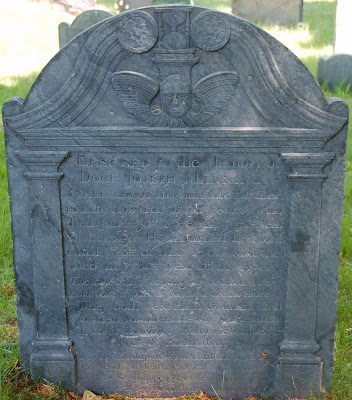
When I was in Ipswich, I came across the gravestone of Joseph and Elizabeth Manning. While their is no "husband of" language, the epitaph does pay homage to an equitable and loving relationship. The language of "Partner in Life" may sound surprisingly modern, but it was not unknown in late-18th-century New England. Think John and Abigail Adams.
Anyway, I thought it was a touching epitaph.
So far, I've only found three "husband of" stones, one in Windham, CT and the others in Lebanon.
When I was in Ipswich, I came across the gravestone of Joseph and Elizabeth Manning. While their is no "husband of" language, the epitaph does pay homage to an equitable and loving relationship. The language of "Partner in Life" may sound surprisingly modern, but it was not unknown in late-18th-century New England. Think John and Abigail Adams.
Anyway, I thought it was a touching epitaph.

ERECTED to the Memory of
Doctr. JOSEPH MANNING
& ELIZABETH his amiable Partner
in Life upwards of 46 years, who
died Jan. 30th 1779 in 71st year
of her age. He mourned her lose [sic]
until ye 8th of May 1784 and then
died in ye 80th year of his Age.
The toile of life and pangs of death are o’er
And care & pain & sickness are no more.
They both were plain and unaffected
in their Manners steady and Resalute [sic]
in their Conduct Humane, temperate,
Just & Bountiful.
Death can’t disjoin whom Christ hath join’d in love,
Life leads to death, and death to life above.
In Heaven’s a happier place frail things despise,
Live well to gain in futer [sic] life the prize.
Doctr. JOSEPH MANNING
& ELIZABETH his amiable Partner
in Life upwards of 46 years, who
died Jan. 30th 1779 in 71st year
of her age. He mourned her lose [sic]
until ye 8th of May 1784 and then
died in ye 80th year of his Age.
The toile of life and pangs of death are o’er
And care & pain & sickness are no more.
They both were plain and unaffected
in their Manners steady and Resalute [sic]
in their Conduct Humane, temperate,
Just & Bountiful.
Death can’t disjoin whom Christ hath join’d in love,
Life leads to death, and death to life above.
In Heaven’s a happier place frail things despise,
Live well to gain in futer [sic] life the prize.
Friday, June 13, 2008
Were Colonial American Slaves Christians?
Cross-posted from my new co-blogging gig over at American Creation:
In March, Pat Buchanan wrote syndicated column called “A Brief for Whitey,” in which he enumerated what he believes to be the “convictions, grievances and demands” of the “Silent Majority” of white Americans. Among Buchanan’s jaw-dropping claims, he parrots the old proslavery canard that slavery was a positive good because it gave enslaved Africans and their descendants the opportunity to become Christians:
In the words of Larry E. Tise, author of Proslavery: A History of the Defense of Slavery in America, 1701-1840, the idea that “American slavery was a blessing to degraded Africans” was “the quintessence, the very heart of American proslavery thought whether colonial or antebellum” (Tise, 32). During the early 19th century, pro-slavery legislators, ministers, and intellectuals argued that slavery was a benign, patriarchal institution that benefited slaves in every way:
Short answer: some were, most weren’t.
This is a tricky question because it is so broad. It is virtually impossible to generalize about the religious practice of all enslaved people in all centuries and all colonies. Even if we ignore the syncretic religions of the Caribbean and Latin America, it is difficult to generalize about African-American religious practice before the Civil War. Some slaves, like Phillis Wheatley, became devout Christians, while others continued to practice African religions or blended religious traditions. In addition, counting Christians is problematic (see Brian’s post and discussion here). For this post, I am defining “Christian” as someone who was baptized into a Christian denomination (Methodist, Baptist, Moravian) or who regularly participated in identifiably Christian rituals (reading/discussing the Gospels, praying to Jesus, etc.), even if those practices included non-Christian elements.
Before the Methodist and Baptist revivals of the early 19th century, very few slaves were instructed in Christianity and even fewer were baptized. Before 1667, slaveowners in Virginia feared that baptized Africans could not be held as slaves under British law. In order to calm their fears, Virginia passed a law stating, “baptism does not alter the condition to the person as to his bondage or freedom; masters freed from this doubt may more carefully propagate Christianity by permitting slaves to be admitted to that sacrament."
Even after this legal question was settled, many masters actively discouraged slaves from attending religious services because they feared that Christianity would make slaves “not only proud but ungovernable, and even rebellious” (Raboteau, 103). In 1740, after the Stono Rebellion, South Carolina passed its infamous “Negro Act,” which forbid slaves from gathering during their free time, even for religious services. These laws were replicated by other states in the 1830s in response to Nat Turner’s Rebellion.
Pre-1800 efforts by missionary groups such as the Society for the Propagation of the Gospel in Foreign Parts (S.P.G.) were generally limited, underfunded, and unsuccessful. In 1720, Thomas Hasell of the S.P.G claimed that after 11 years of missionary work among the slaves in South Carolina, he had baptized fewer than 10 people. In 1713, ministers working for the S.P.G in South Carolina reported that, “The conversion of slaves is, considering the present circumstance of things, scarcely possible. ‘Tis true, indeed, that an odd slave here and there may be converted when a minister has leisure and opportunity for doing so . . . But alas!” (Wood, 142). Silvia Frey and Betty Wood, authors of Come Shouting to Zion: African American Protestantism in the American South and British Caribbean to 1830, argue that Anglican missionary efforts in the colonial period were dismal failures (Anglican Christianity had very little to offer slaves) and that virtually no slaves converted until Moravian missionaries gained footholds in Virginia (1740s) and Georgia (1770s).
In the last years of the 18th century, Methodist and Baptist camp meetings and revivals began to baptize considerable numbers of enslaved people. Despite many difficulties, particularly the laws that prevented most slaves from learning to read and write, thousands of slaves did convert to Christianity during the 19th century. Before 1800, observations like Alexander Hewatt’s (1779) were not unusual:
Slave narratives written in the 19th century often speak of both Christian and non-Christian religious practices among slaves, such as when Charles Ball recounts what seems to him a “traditional” African burial or when Frederick Douglass tells the story of Sandy’s root. Since these narratives were written for political purposes in the 19th century, they are not very good sources for examining African-American religion in the colonial period. I don’t know much about the historical archaeology that has been carried out at slave quarters, but I would be interested in seeing if that work might shed any light on pre-1800 religious practices.
Contrary to the claims of slavery apologists, there is little evidence to suggest that very many slaves were converted to Christianity before the Methodist and Baptist revivals of the 19th century. Some historians even argue that some kidnapped Africans were syncretic Catholics who had been converted by Portuguese missionaries and were prevented from practicing their Christian religion once they arrived in the New World.
Of course, even if it were true that all enslaved Africans became Christians, the narrative of “civilizing the savages” would still be repugnant. All justifications for slavery are odious. In this case, it is not just bad taste; it’s bad history.
In March, Pat Buchanan wrote syndicated column called “A Brief for Whitey,” in which he enumerated what he believes to be the “convictions, grievances and demands” of the “Silent Majority” of white Americans. Among Buchanan’s jaw-dropping claims, he parrots the old proslavery canard that slavery was a positive good because it gave enslaved Africans and their descendants the opportunity to become Christians:
First, America has been the best country on earth for black folks. It was here that 600,000 black people, brought from Africa in slave ships, grew into a community of 40 million, were introduced to Christian salvation, and reached the greatest levels of freedom and prosperity blacks have ever known.There’s an awful lot to unpack in that paragraph, but I will confine myself to the subject of people who were “brought from Africa in slave ships” and “were introduced to Christian salvation.”
In the words of Larry E. Tise, author of Proslavery: A History of the Defense of Slavery in America, 1701-1840, the idea that “American slavery was a blessing to degraded Africans” was “the quintessence, the very heart of American proslavery thought whether colonial or antebellum” (Tise, 32). During the early 19th century, pro-slavery legislators, ministers, and intellectuals argued that slavery was a benign, patriarchal institution that benefited slaves in every way:
What more can be required of Slavery, in reference to the negro, than has been done? It has made him, from a savage, an orderly and efficient labourer. It supports him in comfort and peace. It restrains his vices. It improves his mind, orals and manners. It instructs him in Christian knowledge” (William Johnson Gray, "The Hireling and the Slave," 1855).It is not my intention here to recount the history of proslavery thought. Interested readers can find in-depth treatments of the subject here, here, and here. Instead, I want to ask a simpler question: Were slaves in the American colonies Christians?
Short answer: some were, most weren’t.
This is a tricky question because it is so broad. It is virtually impossible to generalize about the religious practice of all enslaved people in all centuries and all colonies. Even if we ignore the syncretic religions of the Caribbean and Latin America, it is difficult to generalize about African-American religious practice before the Civil War. Some slaves, like Phillis Wheatley, became devout Christians, while others continued to practice African religions or blended religious traditions. In addition, counting Christians is problematic (see Brian’s post and discussion here). For this post, I am defining “Christian” as someone who was baptized into a Christian denomination (Methodist, Baptist, Moravian) or who regularly participated in identifiably Christian rituals (reading/discussing the Gospels, praying to Jesus, etc.), even if those practices included non-Christian elements.
Before the Methodist and Baptist revivals of the early 19th century, very few slaves were instructed in Christianity and even fewer were baptized. Before 1667, slaveowners in Virginia feared that baptized Africans could not be held as slaves under British law. In order to calm their fears, Virginia passed a law stating, “baptism does not alter the condition to the person as to his bondage or freedom; masters freed from this doubt may more carefully propagate Christianity by permitting slaves to be admitted to that sacrament."
Even after this legal question was settled, many masters actively discouraged slaves from attending religious services because they feared that Christianity would make slaves “not only proud but ungovernable, and even rebellious” (Raboteau, 103). In 1740, after the Stono Rebellion, South Carolina passed its infamous “Negro Act,” which forbid slaves from gathering during their free time, even for religious services. These laws were replicated by other states in the 1830s in response to Nat Turner’s Rebellion.
Pre-1800 efforts by missionary groups such as the Society for the Propagation of the Gospel in Foreign Parts (S.P.G.) were generally limited, underfunded, and unsuccessful. In 1720, Thomas Hasell of the S.P.G claimed that after 11 years of missionary work among the slaves in South Carolina, he had baptized fewer than 10 people. In 1713, ministers working for the S.P.G in South Carolina reported that, “The conversion of slaves is, considering the present circumstance of things, scarcely possible. ‘Tis true, indeed, that an odd slave here and there may be converted when a minister has leisure and opportunity for doing so . . . But alas!” (Wood, 142). Silvia Frey and Betty Wood, authors of Come Shouting to Zion: African American Protestantism in the American South and British Caribbean to 1830, argue that Anglican missionary efforts in the colonial period were dismal failures (Anglican Christianity had very little to offer slaves) and that virtually no slaves converted until Moravian missionaries gained footholds in Virginia (1740s) and Georgia (1770s).
In the last years of the 18th century, Methodist and Baptist camp meetings and revivals began to baptize considerable numbers of enslaved people. Despite many difficulties, particularly the laws that prevented most slaves from learning to read and write, thousands of slaves did convert to Christianity during the 19th century. Before 1800, observations like Alexander Hewatt’s (1779) were not unusual:
[T]he negroes of [South Carolina], a few only excepted, are to this day as great strangers to Christianity, and as much under the influence of Pagan darkness, idolatry, and superstition, as they were at their first arrival from Africa (Raboteau, 66).Of course, we can’t take the words of Hasell or Hewatt at face value — the slaves they observed may have been adherents to a syncretic Christianity that was shocking or unrecognizable to ignorant observers. At the same time, we should not privilege the propaganda of antebellum writers who also had their own reasons for inflating the numbers of Christian slaves: slaveowners wanted to portray slavery as benevolent and abolitionists hoped to outrage their countrymen by relaying tales of enslaved Christians such as Uncle Tom and Eliza.
Slave narratives written in the 19th century often speak of both Christian and non-Christian religious practices among slaves, such as when Charles Ball recounts what seems to him a “traditional” African burial or when Frederick Douglass tells the story of Sandy’s root. Since these narratives were written for political purposes in the 19th century, they are not very good sources for examining African-American religion in the colonial period. I don’t know much about the historical archaeology that has been carried out at slave quarters, but I would be interested in seeing if that work might shed any light on pre-1800 religious practices.
Contrary to the claims of slavery apologists, there is little evidence to suggest that very many slaves were converted to Christianity before the Methodist and Baptist revivals of the 19th century. Some historians even argue that some kidnapped Africans were syncretic Catholics who had been converted by Portuguese missionaries and were prevented from practicing their Christian religion once they arrived in the New World.
Of course, even if it were true that all enslaved Africans became Christians, the narrative of “civilizing the savages” would still be repugnant. All justifications for slavery are odious. In this case, it is not just bad taste; it’s bad history.
Wednesday, June 11, 2008
What a Difference the Sun Makes
It was sweltering in Cambridge yesterday, so I took a drive up the coast instead of broiling at home. I started in Newburyport and noodled back down to Boston, stopping at every old graveyard I came across. The colonial graveyards on the North Shore are among the best documented (after the big three in Boston) and I was able to see some famous stones, including several by the Ipswich bird carver.*
The graveyards in Newbury, Newburyport, and Ipswich have one unfortunate feature: trees. These burying grounds were active through the 19th century and it seems that caretakers made some efforts at garden landscaping, such as planting decorative trees. This made these graveyards nice to walk in, but murder for photography.
Colonial-era gravestones look stunning in raking sunlight, but it's tough to photograph them in the shade. What I really need is a 4'x4' mirror or some sort of external flash for taking photographs in shady graveyards.
To illustrate the problem, I took photos of sets similar stones where one was in the shade and the other received raking sunlight.


 Side note: What kind of tragedy struck the extended Appleton family in mid-February of 1697?
All of these pictures were taken in the Ipswich burying ground within five minutes of one another. As you can see, shade makes slate stones appear flat and blue-ish, while sunlight raking across the face brings out every detail of the carving. This means that in order to get a great shot of a stone, you need to catch it at precisely the right time of day, which varies among graveyards and among stones in the same graveyard.
And you have to hope that no one planted any trees nearby.
* Who is the Ipswich bird carver? Actually, "he" is probably a series of carvers active in the Rowley/Ipswich area between 1680 and 1725. These carvers are known for "ornimorphic" or abstract, bird-like motifs. Often, the birds are located on either side of the soul effigy on the lunette and appear to be kissing over the top of the face.

The graveyards in Newbury, Newburyport, and Ipswich have one unfortunate feature: trees. These burying grounds were active through the 19th century and it seems that caretakers made some efforts at garden landscaping, such as planting decorative trees. This made these graveyards nice to walk in, but murder for photography.
Colonial-era gravestones look stunning in raking sunlight, but it's tough to photograph them in the shade. What I really need is a 4'x4' mirror or some sort of external flash for taking photographs in shady graveyards.
To illustrate the problem, I took photos of sets similar stones where one was in the shade and the other received raking sunlight.
Shade: Joseph and Elizabeth Manning, Ipswich, 1784

Sun: Daniel and Joseph Noyes, 1779

Shade: Prissilla Appleton, Ipswich, 1697

Sun: Mary Appleton, Ipswich, 1697
 Side note: What kind of tragedy struck the extended Appleton family in mid-February of 1697?
All of these pictures were taken in the Ipswich burying ground within five minutes of one another. As you can see, shade makes slate stones appear flat and blue-ish, while sunlight raking across the face brings out every detail of the carving. This means that in order to get a great shot of a stone, you need to catch it at precisely the right time of day, which varies among graveyards and among stones in the same graveyard.
And you have to hope that no one planted any trees nearby.
* Who is the Ipswich bird carver? Actually, "he" is probably a series of carvers active in the Rowley/Ipswich area between 1680 and 1725. These carvers are known for "ornimorphic" or abstract, bird-like motifs. Often, the birds are located on either side of the soul effigy on the lunette and appear to be kissing over the top of the face.
Grace Dennis, Ipswich, 1686

Tuesday, June 10, 2008
"I've Lost My Breeches!"
So what did John Boyle write that is so shocking that the NEHGR decided to snip it out of his diary? Nothing as shocking as I had hoped. I had already found most of the redacted entries on my own, and others were just strange.
The lengthiest excluded entry is from August 14, 1773 and concerns a meeting of the Sons of Liberty. The entry is in two parts — the NEHGR printed the first part, but not the second.
This text appeared in the NEHGR in 1930:
Why was this poem excluded? The NEHGR included other poems, as well as lengthy accounts of Wolfe's actions on the Plains of Abraham (copied from newspapers). Was this poem too flippant? Did they dislike the jab at prayer?
Who was the "Sarcastical Genius"? It may have been Boyle himself, since he was able to quote the poem at length. Whoever it was, he portrayed the Sons of Liberty in a manner the NEHGR found "hardly suitable for publication."
The lengthiest excluded entry is from August 14, 1773 and concerns a meeting of the Sons of Liberty. The entry is in two parts — the NEHGR printed the first part, but not the second.
This text appeared in the NEHGR in 1930:
This being the Anniversary of the ever-memorable 14th of August 1765, about 400 of the True born Sons of Liberty convened on Roxbury Common from this and the Neighbouring Towns. There was a superb Tent erected sufficiently capacious to contain the numerous Guests. Unfortunately the Forenoon was wet, which prevented a great Number of Gentlemen, who had engaged their Company from attending the Festivity of the day At the hour of dinner it ceased to rain, and two ranges of Tables were filled about 150 Feet in Length But unhappily for the Guests at the South Table, just after a blessing was asked, and they were seated down, it gave way and fell to the Ground, carrying away at the same time the Benches on which they sat along with it. By this misfortune about 200 Persons, genteely dressed, were mingled with Gravies, Sauces, Salt, Pepper, Sugar, Marrow, Flesh and Bones, Rum, Cyder, Punch and Wine, Plates, Dishes, Knives and Forks However, after this Disaster, the Table was again reared, the Provisions placed, and the Guests sat down. During the Entertainment, a select Band of Musick patroled the Tent, and gladdened the Hearts of the Patriots with the celebrated Song of the Farmer. After an elegant Repast a Number of patriotic Toasts were drank.The NEHGR account ends there, but Boyle's entry continues:
Soon after the Feast, some Sarcastical Genius wrote the following Poem upon the misfortune which attended the Guests at the fall of the Table. — — !!!I almost titled this post "Farewell Commencement Wig."
Howl, Stygian Muse, the Noise and Discord dire,
Of heated ovens, and of crack’ling fire;
While Smoke and Soot, Pots, Spits, and Sticks of Wood,
And Coals and Crock, and Garbage, Guts and Blood,
With hideous Riot, all deform the Floor;
Rage, Fury, Firebrands, Bluster, Outrage, Roar,
Blend in one Chaos. — Lo! the Feast appears,
And Charms at once our Eyes, Nose, Touch, Mouth, and Ears,
Fall on, huzza! break down the Bulwark strong,
Let gravy gush, and Pasty sprawl along,
Salt, Pepper, Sugar, Marrow, Flesh and Bones,
Mix in the Mouth, while Spoons encounter Spoons,
Forks rush at Forks, and Plates on Plates resound,
Knives Knives repel, and Crust recrackles round.
War, Tumult, Havock, Shouts, Intreaties, Threats,
Thunder of tumbling Chairs, Stools, Crickets, Seats,
Wild Scenes of Rapture, Horror, Fun, Despair,
Reach to the Roof, and rattle through the Air.
Rum, Cyder, Punch, their frothing Billows roll,
Tankard on Tankard shower’d and Bowl on Bowl.
“Pour Down the Blessing” was the Chaplain’s Word,
And on them all the Blessings down were pour’d.
The Table totters, and the Leaves at once,
Crash to the Floor in one amazing Bounce.
Now Famine stares, now raves the Fury, Thirst,
Frail dishes clash, and batter’d Bottles burst.
What Din! what Uproar, Outcries, screams and screeches!
“I’ve spoilt my Sunday Coat” — “I’ve lost my Breeches!”
“The Soup (‘twas cold indeed) has scalt our Skins,”
“I’m drown’d in Flip and Custard!” — “O my Shins!”
“Lift off the Table, Oh!” — Pull off this Pig.” —
“Alas! my Hat.” — “Farewell Commencement Wig.”
“Unheard of Hotch-poch! Pudding all this side,
This other all bebutterfishify’d! —
“Help! Help! O pick me from among the spoil,
“O’erwhelm’d beneath this Apple-sauce and Oyl.” —
The pious Parson! — fine bedight was he,
With Grace and Greece, Gravy and Gravity.
Unlucky Chance! — how ruefully bepatch’d!
Befoul’d, bedrench d, bepickl d and bewitch’d,
Besoak’d, besous’d! — the figure of the Man!
A Sop so sputters in a dripping pan:
So, mix’d with Mud, you’ve seen a drowned Cat,
and a brown pancake wallop in Hog’s Fat.
His sole attempt these Blessings could obtain,
Who never pray’d before, and never will again.
Why was this poem excluded? The NEHGR included other poems, as well as lengthy accounts of Wolfe's actions on the Plains of Abraham (copied from newspapers). Was this poem too flippant? Did they dislike the jab at prayer?
Who was the "Sarcastical Genius"? It may have been Boyle himself, since he was able to quote the poem at length. Whoever it was, he portrayed the Sons of Liberty in a manner the NEHGR found "hardly suitable for publication."
Monday, June 9, 2008
John Boyle's Diary and the NEHGR
For the last few weeks, I have been toying with the idea of working with the John Boyle diary in some serious way. It's not the most compelling project I can think of, but it is an important source, and I think that annotating and publishing it would be a great help to many researchers.
This morning, I went to Widener and copied the transcription that appeared in the 1930-1931 volumes of the New England Historical and Genealogical Register (NEHGR). The transcription is preceded by a short introduction, which contains a brief biography and genealogy of John Boyle, as well as the following note:
This morning, I went to Widener and copied the transcription that appeared in the 1930-1931 volumes of the New England Historical and Genealogical Register (NEHGR). The transcription is preceded by a short introduction, which contains a brief biography and genealogy of John Boyle, as well as the following note:
In this article, the REGISTER presents a verbatim copy of John Boyle's "Journal," only a few passages — chiefly verses of no historical or genealogical importance or certain entries hardly suitable for publication — being omitted.As you might imagine, the entries that discuss rape and genital mutilation that I presented here are deemed "hardly suitable for publication." I have found 12 entries that have been wholly or partially redacted, including a tantalizing entry discussing a Sons of Liberty dinner that ends enigmatically:
After an elegant Repast a Number of Patriotic Toasts were drank . . .I'll be in the archives this afternoon and will report back on the unspeakable debauchery.
Sunday, June 8, 2008
Death: "King of Terrors"

I've been trying to track some of the language that I see on gravestones. Lately, I've found several examples of Death personified as the "King of Terrors." The phrase comes from Job 18:14 ("His confidence shall be rooted out of his tabernacle, and it shall bring him to the king of terrors."), in which Job's friend, Bildad, explains how God causes the wicked to suffer because they are guilty of sin.
According to Early English Books Online (EEBO), the earliest printed use of the phrase "King of Terrors" that is not a direct quote from the Book of Job appears in William Prynne's The Perpetuitie of a Regenerate Mans Estate . . . (1626).
If once you haue the smallest dram of true and sauing grace, you need not feare afflictions or temptations, you need not feare the very King of terrors, hell and death: you need not feare the most that men or diuells can doe to you: they cannot seuer you from the loue of God, which is in Christ Iesus your Lord, nor yet disturbe you from the state of Grace.After Prynne's use of the phrase, it appeared in about 200 other English books before 1700. The earliest example I can find in an American printed source is in James Fitch's Peace the End of the Perfect and Uprigh[t] . . . (1672). This was a funeral sermon preached after the death of Mrs. Anne Mason in Norwich (I'm assuming this means Norwich, CT, though it doesn't say):
When she was under the pangs of Death, and Nature could not be at rest, yet I speaking t her whether I should Pray once more with her? to which she readily answered yea, and durinall the time of the Prayer, lay as fully composed as at any time; that either the Lord at that time rebuked the pangs of death, and cauled the King of terrors to retreat his force, or else the Prince of peace would shew us that his peace when he pleaseth shall rule, and that in the Enemies Land, in the midst of the terrours of Death, and that she had to incounter with a Conquered Enemy.Since this was a printed sermon, ministers may have been calling Death "the King of Terrors" in their pulpits for years before.
The phrase was certainly known to common New Englanders by the late eighteenth century. On September 2, 1767, Boston apprentice John Boyle wrote in his diary:
Died in the 18th year of her Age, Miss Mary Boucher, Daughter of the late Mr. Thomas Boucher, Merchant. A young Lady whose inoffensive and exemplary Behaviour very justly attracted the Love and Esteem of all those who had an acquaintance with her. Youth is no defence [sic] against the king of terrors.
 Yet, despite the many 17th-century references, I have not been able to find the phrase on any gravestone before the year 1790, and most of the examples I've found have been from the first decade of the 19th century.
The explanation for this lag may be simple: earlier stones' epitaphs are generally limited to name, date of death, age, and a few short details such as "Wife of xxx." In the late 18th and early 19th centuries, more stones began to bear poems, Bible verses, and laudatory epitaphs. Many of these are very common, such as "As I am now, so you will be, / Remember Death and follow me," "Remember me as you pass by, / As you are now, so once was I," and the ubiquitous "Blessed are the dead who die in the Lord." As epitaphs increased in length, there was more opportunity to include a reference to the "King of Terrors."
What is interesting to me as a student of material culture is that the length of epitaphs increased as the complexity of imagery on the stones decreased. Perhaps "complexity" is the wrong word to use here — I mean the theological significance of carvings and the number of symbols on each stone. At the same time we see explicit references to the "King of Terrors" in epitaphs, we see fewer images of death's heads, imps, scythes, coffins, and hour glasses.
For example, the William Dickson stone (1692) in Cambridge is rich in its imagery of death: imps carry coffins, demons hold darts and hour glasses, and a grinning death's head crowns the whole. The phrase "Memento Mori Fugit Hora" (Remember Death, Time Flies) is part of the lunette design, but the epitaph is fairly short:
HERE LYES THE BODY OF WILLIAM DICKSON AGED 78 YEARS DECD THE 5 OF AUGUST 1692
THE MEMORY OF ye IUST IS BLESSED
 By 1800, epitaphs are a mile long and images have been reduced to plain urn-and-willow designs. I need to do more work on the periodization of these changes, but for now it seems to me that in the 17th century, carvers personified death through images and that over the course of the 18th century, words gradually took over this function. By 1800 or so, there were virtually no images of death on New England gravestones, but epitaphs were full of personifying language.
Subscribe to:
Posts (Atom)