Showing posts with label New England. Show all posts

Wednesday, March 16, 2011

A New Names Series

I propose a new series for VPI:

Scraping the Bottom of the Biblical Names Barrell:
an Alphabet

In this series, I will highlight obscure Biblical names given to New Englanders. I may not be able to find examples for all 26 letters, but I will try.

See today's name of the day for the first installment and check back for updates in the future.

B: Bezer
C: Cozbi
D: Dumah
E: Eliashib
F
G
H
I
J
K
L
M
N
O
P
Q
R
S
T
U
V
W
X
Y
Z

Friday, June 5, 2009

"A Bud From Plymouth's Mayflower"

The Little Compton graveyard is the final resting place of many important New Englanders, including Elizabeth Alden Pabodie, daughter of John Alden and Priscilla Mullins.
When she died in 1717, Elizabeth's family erected an ordinary headstone similar to her husband's. Over a century and a half later, after her great-great-great-great-grandson, Henry Wadsworth Longfellow, made her parents famous in "The Courtship of Miles Standish," Elizabeth got an impressive obelisk. In 1717, she was merely "the wife of William Pabodie." In 1882, she was "the first white woman born in New England."
I'm becoming more interested in the ways in which gravestones were pressed into service in the creation of a distinctive New England identity in the 18th and 19th centuries — this is a great example of how commemoration changed over a century and a half.
Whoever erected the monument also composed a poem:
A bud from Plymouth's Mayflower sprung,
Transplanted here to live and bloom,
Her memory, ever sweet and young,
The Centuries Guard within this tomb.

Monday, February 23, 2009

Bodies Politic

I recently finished reading John Wood Sweet's Bodies Politic: Negotiating Race in the American North, 1730-1830 (2003). In part, this book is a project of recovery — Sweet points out that while "American came to present itself as a white nation," the reality was that "it was, and had been from the start, diverse, hybrid, and multiracial" (10). His basic argument is that racism in 18th-century New England was not a matter of cultural misunderstanding — in fact, as people of color converted to Christianity and assimilated other aspects of European culture into their daily lives, they found themselves even more reviled by their white neighbors. Over the course of the century, "stubborn, essentialist identities of race . . . supplanted a potentially mutable form of difference — culture" (108). The larger point is one that is often difficult for proud New Englanders to swallow: even though the Civil War pit North against South, the war and its memory "has obscured underlying similarities that derive from a shared legacy of colonialism" (11).

I recommend this book to anyone with an interest in American History, particularly if that interest is focused on southern New England. Sweet's title says "the American North," but what he really means is Rhode Island with some eastern Massachusetts and a smattering of Connecticut. That was great for me — I love Rhode Island history —but readers looking for Pennsylvania or Maine will be disappointed.


Bodies Politic is a thick book (409 pages), but an easy read. Sweet employs many engaging vignettes to make his points, which makes this a great book for the casual reader or for the academic looking for some arresting anecdotes for lecture.

The one scene that stayed with me after reading this book was the opening paragraph of Chapter Four:
When Paul Revere set out on his midnight ride in April 1775, one of the first landmarks he passed was the body of a long-dead slave — a figure that represented, no less than the Sons of Liberty themselves, a colonial family drama of abused paternal authority, emasculating enslavement, and rebellion. Revere knew the body by name. Mark's remains, suspended in a metal gibbet overlooking the road, had been greeting travelers for some twenty years — since 1755, when he was hanged. His accomplice, Phillis, was burned at the stake. Their crime had been killing their master, Captain John Codman of Charlestown.
I was already somewhat familiar with the case of Mark and Phillis because all the graduate students have been talking about Blindspot lately, but I hadn't really assimilated the image of the gibbet into my mental picture of late colonial Boston. When I think heads on spikes or bodies suspended near the road, I'm thinking 17th-century Ireland or the Caribbean, not Stamp Act-era Boston. You won't see any gibbets in the John Adams miniseries, that's for sure. Now, I have adjusted the image in my mind, though I can't quite imagine what a 20-year-old exposed corpse looks like. Blanched bones? Strips of ragged cloth? A pile of dust?

Friday, January 16, 2009

Learning to Read in Puritan New England

Between the end of the 17th and the end of the 19th century, most New Englanders learned to read from The New England Primer. This book included an alphabet, short passages, and a catechism (John Cotton's Spiritual Milk for Babes).

You can find the illustrated alphabet on the wikipedia page. Note that there are only 24 letters (I/J and U/V are combined). You may recognize some of the couplets:

A:
In Adam's fall,
We sinned all.
B:
Thy life to mend,
This Book attend.
F:
The idle Fool
Is whipt at school.

In one section, pupils are given lists of words with the same syllable count. The monosyllablic words are fairly tame (God, child, grace, knit), as are the disyllabic words(boldly, father, husband), but things get a little strange in the 3+ categories. Here are the first four trisyllabic words from the 1727 version:
Abusing
Bewitching
Confounded
Drunkenness
Cheery, no? The polysyllabic lists aren't quite as dreary, though you will find "Discontented" in the four-syllable list and "Fornication" on the five-syllable list.
The primer also includes some short prayers, such as the well-known "Now I lay me down to sleep. . ." For obvious reasons, I found this one more interesting:
I In the Burying place may see
Graves shorter there than I;
From Death's arrest no age is free,
Young children too may die.
My God, may such an awful sight
Awakening be to me!
Oh! that by early Grace I might
For Death prepared be.

Monday, July 7, 2008

Neoclassical Republicanism and New England Gravestones

Cross-posted from American Creation.

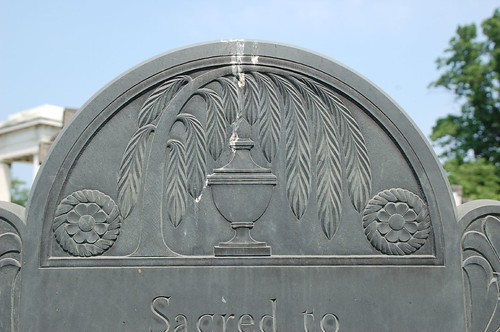
In the last decades of the eighteenth century, New England gravestones underwent a stylistic revolution that mirrored the country's political revolution. The deep, plastic, organic shapes of the 17th and early 18th centuries gave way to light, planar, geometric forms (this swing from the sensual to the cerebral can also be observed in furniture, tableware, picture frames, and many other types of material objects — a phenomenon is called “shared mental structures”). In addition to these stylistic changes, the content of gravestone decorations shifted from soul effigies, spiritual breasts, and other religious symbols to neoclassical elements such as urns, willows, columns, and laurel wreaths.

These artistic transformations reflect an evolving worldview in which classical republican ideas and aesthetics (as filtered through popular understanding of the Enlightenment) encroached on the provincial culture of New England Puritanism. While Americans’ interest in the ancient republics translated into an explosion of neoclassical style in popular culture (town names, architecture, people signing letters to the editor with classical names), many New Englanders were uncomfortable with the growing influence of “reason” when they thought that it might threaten their religious traditions.

New England gravestones from the period 1770-1820 illustrate ordinary people’s attempts to accommodate both neoclassical and Christian ideas into their eschatologies.

During the period 1690-1770, New England gravestones were typically tripartite slabs decorated with symbols and bearing short, factual epitaphs. While there was considerable variation and development in gravestone art during this period, most stones (particularly pre-1750) featured natural images (such as vines, breasts, flowers, and hourglasses) that had theological significance. For example, the breasts visible on many 17th-century represent the Scriptures, which provided “divine milk” to nourish the soul. As Edward Taylor (1642-1729) wrote,
Lord put these nibbles then my mouth into
And suckle me therewith I humbly pray,
Then with this milk thy Spiritual Babe I'st grow,
And these two milke pails shall themselves display
Like to these pritty twins in pairs round neate
And shall sing forth thy praise over this meate.

If you think that’s a little weird, don’t read anything written by 17th-century Franciscans.

Epitaphs from the pre-1770 period typically focus on the physical presence of the body and often begin with “Here lies buried . . .” or “Here lyes the Body of . . . ” or “Here lies the mortal part of . . .” The earlier the stone, the less likely it is that it will have any epitaph beyond the deceased person’s name, date of death, and age (women also often have their husbands’ names and ministers were more likely to have more elaborate epitaphs). When ordinary people do have a verse after their biographical information, it is usually a one-liner such as, “Ye memory of ye just is blessed,” or “Blessed are ye Dead who die in ye Lord.” The religious beliefs of the community are conveyed through images and placement (stones often face East so that the dead can sit upright at the last trumpet), rather than through words.

After 1770, the images on New England gravestones underwent a profound stylistic shift. Instead of the undulating leaves, death’s heads, and winged soul effigies that adorn earlier stones, gravestones of the late 18th century are typically decorated with columns, urns, and weeping willows. It is very rare to find a stone from the 1800-1820 period that is not ornamented with these neoclassical symbols. At the same time, gravestones began to lose their function as markers of the location of a body awaiting resurrection and came to be regarded as memorials to benefit the living. Instead of “here lies,” these epitaphs began with “Sacred to the Memory of . . .” or “Erected in Remembrance of . . .”

Yet, even as New Englanders embraced the neoclassical aesthetic, they remained skeptical of rationality’s ability to fulfill their spiritual needs. As the religious decorations disappeared, they were replaced by epitaphs that affirmed the deceased’s religious faith. Whereas earlier stones expressed the person’s hope for salvation pictorially, stones cut in the neoclassical style often have verses added to the epitaph to assure the reader that the dead, “died in hopes of salvation through his merits.”

New Englander’s ambivalence toward the Enlightenment worldview is best summarized by the gravestone of Oliver Miles of Concord, who died in 1820 at the age of 82. His stone, like many others of the period is decorated with the geometric columns, urns, and subtly incised borders that characterize the neoclassical style. Despite this aesthetic choice, his epitaph reads:
Can reason’s dictates be obey’d?
So weak alas! Her strongest aid;
O let religion then be nigh,
Her consolations never die.

Epitaphs also illuminate the tension between republican ideology and traditional New England Congregationalism’s idea of what constituted a life well lived. The ideal republican citizen was judged by his good works in service to the polity, while Congregational theology abhorred any “doctrine of works.” (I don't mean to say that neighborliness and service to the community were unimportant to earlier New Englanders, but these virtues were grounded in a specifically Christian milieu.) Famed patriots such as General Washington were not beloved because they were men of great faith, but because they were men of great deeds and “character.” The tension between these two systems of merit plays out in epitaphs during the Early Republican period. While the rare pre-1750 epitaph that enumerated a person’s good points generally confines itself to his/her piety and sobriety, later epitaphs extol the deceased’s “usefulness,” “civic spirit,” and good works, as well as his/her faith. Such is the case on the John Cuming stone (1788) in Concord, MA:
Naturally active as to genius & disposition, he early appeared on the stage of life, where he conducted with spirit & dispatch & acquired honor in different stations. As a physician, he was, beloved, useful, & celebrated. His compassion for the distressed hastened him to their relief; & his hand was as charitable as healing to the poor; — and as a Magistrate, he magnified his office, nor held the sword of justice in vain. Constitutionally particular, animated & warm in his disposition & temper, earnestness & zeal, affection & precision were his characteristics: hence from his youth, in conversation, he was cheerful & affable; in civil business, prompt and expeditious; in private & public worship, punctual and fervent; in charity liberal; in piety devout. His learning, dignity, and donations procured him an honorary degree from Harvard College: to that society for the support of a Professor of Physic, & to the Church and Town of Concord, for public, charitable, and religious purposes, he made generous donations in his last will.
The Righteous shall be in everlasting Remembrance.

A century earlier, Cuming's donations, public service, and civic virtues may not have been as important to his position as one of the “righteous,” but they were clearly important to his community in 1788.

Some New England epitaphs from the Early Republican period focused solely on the deceased’s good citizenship, excluding any mention of religious virtue. By 1805, Thomas Hunt could be remembered as a good man and a solid citizen, even if piety was not among his memorable qualities:
Here lies the remains of
Mr. Thomas Hunt
of Concord, late of Boston
who died Jan. 8, 1805, Aetat 22
Tho’ death consigned him to an early grave, his amiable life and sprightly talents will long survive in the recollection of those who knew him. His heart was formed for friendship and society and embraced in its affections his country’s good. The millitary [sic] science was his pride, and early he became a member of a volunteer company in Boston, in which he acquited [sic] himself with honour, his energies in vindicating the injured rights of his country, were justly anticipated.

I’m sorry that all of these examples are from Concord — I just visited last week, so they’re fresh in my mind and I have pictures. For non-Concord examples of stylistic progression, please see this follow-up post.

These are just a few of the thousands of gravestones in New England, but they are representative. There’s no question that religion was important to the New Englanders of the Early Republican period, but Christian faith was no longer the only important criterion for determining the value of an individual life. After the Revolution, patriotism and civic “usefulness” offered an alternative way for people to live a good life.

Monday, June 23, 2008

In Small Things Forgotten

I'm packing up my books this week in preparation for a move next month. In the packing, I came across a book that is near and dear to my heart: In Small Things Forgotten: An Archaeology of Early America by James Deetz.

I received this book as a high school graduation gift from a family friend who is an archaeologist. At the time, I was planning on studying 19th-century America, and this book was my first nudge toward an earlier era.

In Small Things Forgotten is a light introduction to Deetz' work on the material culture of colonial New England. His historical argument is that colonial Americans forged new vernacular cultures out of Old World traditions and local conditions, but his larger point is that historical archaeology can offer substantial evidence of historical actors' "worldviews."

Deetz opposes the (now somewhat outdated) idea that either migration or transportation across the Atlantic was so traumatic that it erased any Old World cultural survivals. He finds substantial evidence that African-American material culture was substantially different from Anglo-American material culture in ways that cannot be explained by differences in wealth, supporting the idea that enslaved people retained aspects of West African culture well into the 19th century. These difference include a 12-foot rather than a 16-foot standard measurement, traditions of grave decoration, distinctive methods of building construction, and the survival of West African pottery forms. Unlike David Hackett Fischer, Deetz does not argue that colonial Americans transported their traditions wholesale. Rather, he argues for the creation of new vernacular cultures, more like Peter Wood's argument in Black Majority.

I love this book because it has something for everyone. It is written in a casual, accessible style that won't scare off a popular audience. The individual chapters offer primary evidence and gentle arguments in essay formats that are short and useful — perfect for high school or introductory undergrad reading assignments. Professional scholars with a background in material culture might not find much to chew on, but more traditional historians could benefit from an introduction to the possibilities of historical archaeology. All in all, more useful than many more "serious" tomes.

Sunday, June 8, 2008

Feare Nye

Another good colonial American name:

Feare Nye.

She died on October 9, 1774 at age 25, and is buried in Falmouth, MA.

Tuesday, May 27, 2008

Deliverance Mesenger

I've been a little distracted lately, so it took me until now to realize that

Deliverance Mesenger

is also a pretty funny Puritan name.

Breasts, Figs, and Gourds

I have written about breast/fig/gourd motifs before, but the Marblehead examples are not the most literal depictions of vessels of the "divine milk."

The old graveyard next to the Unitarian Universalist church in Harvard Square holds several better examples of this interesting type of imagery. Unlike many of the Marblehead gourds, the Cambridge figures are round and full. Often, the presence of a lifelike face on the finial reinforces the images' association with breasts. The border of the John Wattson stone (1711, image at right) is particularly explicit. It takes only a little imagination to interpret the design under the face as a cravat with breasts protruding underneath.

While these objects may be interpreted as gourds or figs, Ludwig makes a strong case for the presence of both literal and metaphorical breasts in Puritan iconography. According to Jonathan Edwards, "Milk represents the word of God from the breasts of the church . . . Milk by its whiteness represents the purity of the word of God; it fitly represents the word because of its sweetness and nourishing nature" (Ludwig, 155). Then, there is that naughty Edward Taylor poem . . .

The Jane Dickson stone (1689) features two styles of breasts/figs/gourds, both under finial faces. These are particularly interesting because, instead of the ministerial cravats of the John Wattson stone, these heads wear collars of leaves, evocative of contemporary representations of Native Americans. The pendulous ovals hanging down from the collars look very like breasts, as do the circles below them. The bumpy shapes near the bottom look more like gourds to me.

There are plenty of other examples, and it would be tiresome to list them all. Just rest assured that if you visit the old Cambridge cemetery, you'll see a whole lot of Puritan boobs.

Friday, May 23, 2008

Mount Auburn Cemetery

I spent most of the day walking to, from, and around Mount Auburn Cemetery in Cambridge.

I'll post about the gravestones later, but for now, here are pictures of some of the birds I came across today. I'm embedding a Google Docs presentation for the first time - hope this works.

Thursday, May 22, 2008

"She Was a Prude . . . nt, Loving, Virtuous Wife and Mother"

On our way home from Columbia, my sister and I swung by the Windham, CT graveyard as well. It was starting to rain, so we didn't stay long, but I did manage to make a few good finds.

My favorite was the Elisabeth Huntington stone (1733), which displays this post's titular quote. The carver (possibly Obadiah Wheeler) ran out of room for the seventh line of the inscription, resulting in this unfortunate phrase:
If you squint, you can see the faint "nt" carved in above the end of the line. Poor Elisabeth Huntington.

Another good find was the Thomas Huntington stone (c. 1730), which states that Thomas was "Husbband to Mrs. Elizabeth Huntington" (not the Elisabeth Huntington previously mentioned - his wife's stone is nearby and the Huntingtons were a big family - see my previous post on the popularity of the name Elizabeth). It is probably significant that this stone was carved by Obadiah Wheeler, who is also known as "the Collins master," and the Lebanon stones that mention husbands were carved by Benjamin Collins. In Graven Images, Ludwig argues, "either Benjamin Collins learned about carving from the Collins master or he might himself has been the Collins master" (Ludwig, 382). Other scholars have determined that Wheeler was the Collins master, but Ludwig is probably right about there being a close connection between the two. So far, all the stones I have found that mention that the deceased was the husband of so-and-so came out of this workshop.

There were a few other notables, including the Nathaniel Backus stone (1720), which was made by the Norwich Ovoid carver, the Anne Mason stone (1724) by John Hartshorn, and the Lydia Gray stone (1706?), which is very much like the Miriam Walton stone and the Arnold Coddington stone (1742) in Providence, but I don't know the carver by name.

"Old Yard," Columbia, CT

Yesterday, I took my little sister to the old burying ground in Columbia, CT. This is a sweet little graveyard, but it is neglected. There's lots of overgrown grass, which is actually something of a blessing, since lawnmowers do a lot of damage to gravestones.

The Lydia Bennitt stone (at right) is probably the most famous stone in the yard - Allan Ludwig uses it as an example of Zerubbabel Collins' later work in Graven Images: New England Stonecarving and its Symbols, 1650-1815. This gravestone is notable for several reasons: it's one of the few marble stones in the area (Collins sent it back to Connecticut after he moved to Vermont in 1778); it's beautiful and intricate; it displays the wonderful name Henchman Bennitt; and it has the price carved on it! I originally thought that the price was supposed to be hidden below ground level, but it is so close to the bottom line of the poem that I'm not entirely convinced. Also, I love the little wig on the soul effigy's head.

The Columbia graveyard slopes down away from the road, ending with a stone wall that marks the border with the woods. The gravestones are bunched close together near the road, but fewer are placed on the bottom of the slope. Very few are near the stone wall, of which these three are the most prominent:
These three stones (honoring William Goger, John Fowler, and Samuel Guild) are notable because they commemorate men who died during the smallpox epidemic that hit the area in March of 1771. I don't know for sure, but I speculate that these men were buried at some distance from the other graves in order to contain their disease in a seldom-visited corner of the graveyard.

All three stones appear to be the work of Zerubbabel Collins or someone in his workshop. They are stylistically similar to the Lydia Bennitt stone, but are somewhat rougher in their details. The most interesting thing about them is that two of the three explicitly mention the cause of death, which is fairly unusual.
I think that these men were probably prominent members of the community. Two were in their 60s and age was generally venerated in colonial New England. Their gravestones are not as sophisticated as Lydia Bennitt's, but they are still large and elaborate. If it is true that Goger, Fowler, and Guild were rich or powerful, I wonder how many other smallpox victims are buried in that seemingly empty corner of the graveyard.

Visitors to Columbia's graveyard will also find the graves of Sarah Wheelock, wife of Eleazer Wheelock, and two of her infant sons.

Tuesday, May 20, 2008

Windsor, CT Names

As you may have discerned, I love 17th-century names. Even when I am supposed to be doing other work, I often find myself thumbing through indices and vital records, looking at names.

Last semester, I was working on a project about the Dorchester Removal, a 1636 incident in which most of the town of Dorchester, MA picked up stakes and moved to the Connecticut River Valley. As part of my research, I converted the Connecticut Historical Society's 1930 publication of the Windsor church records into a handy little database. This allowed me to discover many interesting tidbits, such as average age of marriage, family size, instances of bridal pregnancy, etc.

Unsurprisingly, my favorite side project involved analyzing the Windsor settlers' names. Here are some of my findings:

1. The top five names were very popular.
Today, many parents attempt to avoid choosing common names for their children, hoping that their baby won't go through school as "Joshua S." or "Emily D." In the 17th century, parents weren't so worried about that. Among the 478 girls born in Windsor (1637-1684), 65% shared the top five female names. About 51% of the 533 boys of the same generation shared their top five.
Among the older generation, the breakdown between top five and other names is exactly the same as for their children.
2. Old Testament names are more common among the younger generation.
You'll notice that among the top five names for both males and females, Old Testament names (Sarah, hannah, Abigail, Joseph, Nathaniel, Samuel) are slightly more common among the younger generation.

The real difference becomes apparent when you look at the other names. (I was very pleased that the percentages were identical for both the older and younger generations. It saved me a lot of messy conversions.)

Among babies born in Windsor who did not have top five names, 53% of girls and 68% of boys bore Old Testament names. Their parents were much less likely to have Old Testament names (35% of women and 29% of men, excluding those with top five names). To me, this suggests that members of the older generation were born to more secular families, turned to stricter religion later, and named their own children in honor of their new faith.

3. Some families liked to name their children after particular Bible stories.
Sometimes, children were named in honor of groups of characters in the Bible. The best example of this is the case of the Cook children: Moses (b. 1645), Aaron (b. 1640), and Miriam (b. 1642). Of the 1,011 children born between 1637 and 1684, only three are named Abraham and each of them has a brother named Isaac. I think that this is evidence that the Windsor settlers thought of themselves as Biblical actors recreating the history of the Old Testament.

4. Some names have me stumped.
Most of the Windsor names come from the Bible. Others are secular English names (Jane, Alice, Henry). Some are a mystery to me. If anybody knows the origins of the names Benaga (male), Bethiah (female), or Asubath (female), please let me know.

Monday, May 19, 2008

Speaking Stones

At the Trumbull Burying Ground, I found another interesting item: the Ephraim Terry stone (1797).

The most obvious anomaly here is the style, which is anachronistic for the 1790s. By that time, gravestones in Providence, Marblehead, and other well-connected places were moving toward lightly-inscribed urn-and-willow designs. In contrast, the Ephraim Terry stone has a deeply-carved, sensuous design and a curvy outline, indicating that it derives from older styles. This isn't surprising because Lebanon was (and is) a small, rural hamlet, not an urban center, so the aesthetic sense may have been a bit provincial. The style of the face and pointy wings indicate that this stone was carved by a member of the Manning family, possibly one of Josiah Manning's sons, Rockwell or Frederick, or a member of his workshop. For more info on the Mannings, see Allan I. Ludwig's Graven Images: New England Stonecarving and its Symbols, 1650-1815, page 409.

But the thing that interested me most was the inscription, which contains a curious misspelling of "departed" as "depated" with the "r" added in later:
This (mis)spelling can also be found on the William Pabodie stone in Little Compton, Rhode Island:
Just try saying "depated" with a short a and presto, you sound like you're from Fall River. The fact that more than one carver made the same mistake indicates that the southern New England accent was light on the "r"s, even in the eighteenth century. There's another stone in Lebanon that says that someone died in "Novemba," but I wasn't able to find it on this trip - I'll look again next time. If these gravestones are any evidence, the colonial New England accent is best preserved by modern residents of southeastern Massachusetts/northern Rhode Island.

One last interesting thing: if the carvings preserve a pronunciation, it probably means that the carvers may have been literate enough to write phonetically, and someone was literate enough to catch a spelling error.


Update:
I found another one! This example is from the Brooklyn, Connecticut cemetery next to the fair grounds. Jane Tyler "Depated" this life in 1741.

Monday, April 28, 2008

Puritan Name Award

Today's Puritan Name Award goes to

Dr. Cotton Tufts

of Weymouth, Massachusetts.

Although Dr. Tufts (1734-1815) was born in the 18th century, his name made me giggle, so he merits an honorable mention. I know you New Englanders want to honor the great men of your regional history, but if your last name is "Tufts," don't you think you'd stay away from "Cotton"?

Thursday, April 24, 2008

17th-Century Names

Today's Puritan name comes from Windsor, Connecticut, where
Jezabel Wilson

was born on February 24, 1673.

She's no Godbert Godbertson, but I think it's a little cruel to name a little girl Jezebel in such a religious community. Perhaps her parents (the more conventionally named Samuel Wilson and Mary Griffen) wanted to inculcate humility or emphasize the depravity of all people, even babies. Even so, imagine carrying that name into your pew every week.

Dore illustration via.

Friday, April 18, 2008

African-American Gravestones of Rhode Island

I love gravestones. I know lots of people do, but it was really gravestones that got me into this whole colonial America/material culture thing.

I grew up in eastern Connecticut, where colonial-era graveyards are a staple of the landscape, and I spent many hours wandering around in them. My mother participated in a project to document all of the graves of Civil War soldiers in our area, and my brothers and I would often spend weekend afternoons searching local churchyards for soldiers and men who were the right age for service. I always found the older stones particularly fascinating. Just writing this makes me want to put aside my paper prospectus, grab my camera, and head out to the nearest boneyard for a joyful afternoon.

Since I cannot justify that at the moment (damn you, homework!), I'll post some photos from Rhode Island. These are from the African-American sections of Newport's Common Burying Ground (Bull), Providence's North Burial Ground (Borden), and a cemetery in Bristol, RI (Burt).

Newport's merchants were rich enough to erect expensive gravestones for their slaves (you'll see the same thing in Marblehead), so the Newport Burying Ground is one of the best places to see funeral art commemorating 18th-century slaves. If you get a chance to visit, the African-American section is at the bottom of the hill near the corner of Van Zandt Ave and the appropriately named Farewell St.

The most interesting of these three stones is Patience Borden's. One can imagine that Borden may have written the epitaph herself, making sure that her identities as a free person, a Christian, and a wealthy, benevolent woman would be remembered by the community. If you are in Providence, you can find Patience Borden's monument (along with those of a few dozen other free and enslaved African-Americans) in the North Burial Ground about 100 ft to the west of the Stephen Hopkins monument.

Photo credits to Robert Emlen, who taught me the value of a well-composed slide.

Peoples of a Spacious Land

In Peoples of a Spacious Land, Gloria Main summarizes the historiography of the 17th-century New England family from the 1980s to the present. In general, she is attempting to provide a broad overview rather than make strong, original arguments. Where she does argue, Main supports those authors who have challenged the idea that Puritans were stern patriarchs, preferring to portray the Puritan family in New England as loving, cooperative, and resourceful in the face of unexpected challenges. Rather than a well-organized colony dominated by a powerful elite, Main emphasizes the improvised nature of New England’s development as residents responded to local environmental, political, and economic situations.
Main supplements her summary with readings from the diaries of leading men such as Samuel Sewall, Cotton Mather, and John Winthrop, as well as those of some lesser-known colonists. Main does not attempt to analyze these sources in depth — rather, she uses them to illustrate the arguments made by other historians.
I do not wish to imply that this book is without merit. In fact, it is very useful because it condenses the arguments made by Ulrich, Thompson, Fischer, Allen, Demos, Cronon, Anderson, Bailyn, and many others (including anthropologists/archaeologists who have studied pre-contact Native Americans) into a readable overview. This would be an excellent text to use as an introduction to New England history because it touches on so many of the debates in the realms of environmental, economic, and family history (it is noticeably light on religion and politics).
My major criticism of Peoples of a Spacious Land is that the promise implied by the plural “Peoples” is never realized. Although Main declares that her work “compares English to native ways in order to explore the influence of cultural values,” most discussion of Native Americans seems overly speculative and is not well integrated into the book. At times, Main seems to be struggling to find something to say about any Indian group (at times extrapolating possible features of Narragansett culture by mining scholarship on other groups, including modern natives of Paraguay) just to fit her initial framework. These pieces seem tacked on and are not very useful. She does not really discuss how English observation of Indian habits might have shaped the colonists’ thinking about themselves and their new home and vice versa. Instead, the reader is left to compare the cultural norms of the two groups, but without any meaningful discussion of how they might have interacted in the 17th century.

Thursday, April 10, 2008

Coming Over


I'm working on a prospectus for an essay on female migration from Europe to the Americas in the 17th century. The central question is why there was such a disparity between the volume of male and female migration at the time. The fact of the gender imbalance is well established, but there is still considerable disagreement over the motivations that led to migration.

There are two principal types of arguments about the reasons that people moved to America: the "push" and the "pull" arguments. "Push" arguments say that migrants left there homes in order to escape intolerable conditions such as religious persecution, unemployment, famine, etc. "Pull" arguments contend that Europeans were lured to America by the promise of opportunity, social advancement, etc.

One of the books I'm examining is Coming Over: Migration and Communication between England and New England in the Seventeenth Century by David Cressy (1987). Cressy rejects the "push" argument that other historians such as Carl Bridenbaugh, Samuel Eliot Morrison, and Virginia DeJohn Anderson have embraced; that is, Puritans emigrated because they faced religious persecution in England. Instead, he emphasizes the individuality of each migrant's decision and the multiplicity of religious, economic, and personal motivations that inspired his or her to move to New England.

Although Cressy is pretty good about acknowledging the difficulty of ever pinning down exactly why any person decided to migrate, he does advance a modified pull argument. Personal tragedy or economic hardship might have given someone a nudge, but Cressy explains migration as an opportunity for advancement.

The one thing I'm not convinced by is Cressy's dismissal of involuntary migration. He discusses reluctant servants briefly, but says that Irish convicts, Scottish captives, and other coerced emigrants are an anomaly. This may be true of New England residents, where forced migration may have accounted for as little as 10% of the population, but in general, forced migration was the rule rather than the exception in the 17th century. While historians readily acknowledge that this was the case for Africans, the consensus that most British migrants were forced as well is more recent.

Next up: Lorena Walsh and Lois Carr's "The Planter’s Wife: The Experience of White Women in Seventeenth-Century Maryland."

Wednesday, April 9, 2008

Changes in the Land


It's been a while since I posted about my reading. Today, I have William Cronon's Changes in the Land: Indians, Colonists, and the Ecology of New England (1983), one of the most important works of environmental history.

Page 123:
Two major consequences followed when snow melted on cleared lands. For one, the longer retention of snow in forested areas acted to keep fires from spreading in the early months of spring; cleared lands were thus more susceptible to the burning colonists used to remove woody vegetation from them. More importantly in the long run, because the snow acted as a blanket maintaining soil temperatures, snow removal meant that soil froze to depths that it rarely had when forested.
Cronon describes how Native Americans and English colonists altered their environment, which was simultaneously undergoing natural changes. Changes in the Land was (and is) an important book for several reasons, including its disruption of the idea that Native Americans did not modify the landscape and its discussion of how Indians and colonists misunderstood each others' relationships with the land. In addition, this book speaks across disciplines, which is something the we Am Civvers always like.

In addition to its useful arguments and clear writing, Changes in the Land is a recipient of the VPI Grad Student Seal of Approval, which is awarded only to books that make their points in fewer than 250 pages. At 170 pages, it is a light morning's worth of reading.