Saturday, May 24, 2008

Confederate Monumental Landscape: Argument

On a clear June day in 1917, Confederate veteran Leigh Robinson looked out across the fields of Gettysburg and addressed over 2,000 of his fellow veterans, government officials, and interested onlookers. They had gathered together to dedicate a new monument to the Virginians who fought on that field in 1863, the first of many monuments that would commemorate the valor of men from each of the eleven Confederate states. For over two hours, Robinson spoke on a wide range of topics, from the Constitution to the life of Robert E. Lee to the works of Plutarch. At every turn, Robinson defended the Confederate soldiers and their cause against imagined aspersions cast against them:
There is a voice which says: All this heroism was “ghastly error;” heroism for a cause which was intrinsically false — false to the rights of man. They who so speak think all too lightly of a cause hallowed by such sacrifice. In memorials, like the present, is felt the refutation of the charge. There are things too high, too deep, too appealing to the genuine grace of sympathy, for memory to be other than a shrine (source).
For Robinson, as for millions of Americans who visit the Virginia monument every year, the Confederate memorial landscape at Gettysburg affirmed a belief that the Confederate cause was worthy because it was consecrated with the blood of courageous men. Over the course of the twentieth century, Southern states, memorial societies, and Civil War enthusiasts erected over a dozen additional monuments to Confederate valor at Gettysburg, enshrining the mythology of the Lost Cause at America’s most famous and most visited Civil War site.

Unlike the Union monuments at Gettysburg, which often commemorate a single regiment or individual, nearly all of the Confederate monuments are dedicated to the men of an entire state. Only four individual Confederate regiments have their own monuments at Gettysburg, and only one of those was erected prior to 1985.* Each of the eleven ex-Confederate states erected a monument at Gettysburg between 1917 and 1982, and several border states, including Kentucky and Maryland, dedicated their monuments to both Union and Confederate soldiers. These thirteen monuments, along with the Confederate Soldiers and Sailors Monument and a handful of other, smaller markers, form a monumental landscape that is distinct from its Union counterpart in style, intention, and physical placement.

Whereas the Union monumental landscape was a project of the nineteenth century directed mostly by veterans, the Confederate landscape is a twentieth-century creation. By the time the Virginia monument was erected in 1917, few Confederate veterans were alive to attend its dedication, and fewer still survived until the second state monument was dedicated by North Carolina in 1929. While Union monuments on the field marked the position of Northern regiments, the monuments erected by the grandsons and granddaughters of the Confederacy were more concerned with shaping the memory and controlling the meaning of their ancestors’ actions. In their style and form, the Confederate monuments tell a tale of heroic valor, desperate suffering, and unsurpassed glory. In inscriptions and dedication speeches, the builders of these monuments made their intention to support a pro-Confederate history of the battle and of the war explicit. In their placement at Gettysburg, the monuments stand as “sentinels of stone,” protecting and promulgating the mythology of the Lost Cause.

“[T]he Lost Cause was expressly a rationalization, a cover-up,” writes historian Alan T. Nolan in his essay, “The Anatomy of the Myth.” In the years following the Civil War, Confederate veterans and their sympathizers attempted to justify the Confederacy’s actions by rewriting the history of the war. This revision involved several key tenets, including idealizing Southern soldiers as “heroic, indefatigable, gallant, and law-abiding,” vilifying the North as meddlesome, heartless, and immoral, and trivializing the role of slavery as a cause for sectional conflict. By the early twentieth century, the mythology of the Lost Cause had come to dominate the nation’s memory of the Civil War. In movies, children’s stories, and academic histories, Confederates were portrayed as chivalric defenders of a noble, but doomed, way of life.

Equally important is the narrative of reconciliation, which holds that the resolution of the military conflict put to rest all of the concerns that had originally sparked the war and that reunification reaffirmed the bonds that tied white, Christian, native-born Americans to one another and to their nation.

The Confederate monuments at Gettysburg support the claims of the Lost Cause mythology by presenting heroic, slave-free images of Confederate soldiers to the battlefield’s millions of visitors. Although most professional historians now recognize the Lost Cause as an egregious distortion of nineteenth-century history, the story presented by the Confederate monumental landscape continues to influence the public’s memory of the Civil War.

*The 2nd Maryland Volunteer Infantry (C.S.A.) erected a small granite monument on Culp’s Hill in 1886. Monuments honoring the 26th and 43rd North Carolina Infantry regiments were dedicated in 1985 and a monument to the 11th Mississippi went up in 2000. For more info on monuments, check out Virtual Gettysburg, which has a wonderful, free, searchable database (with pictures!).

Confederate Monumental Landscape

I recently finished a research paper on the Confederate monumental landscape at Gettysburg. I enjoyed writing it and my professor was encouraging, so I may try to turn it into something publishable.

My central argument was that the Confederate monuments at Gettysburg are specifically designed to preserve the mythology of the Lost Cause by presenting it to 20th and 21st century. I built this argument by examining three aspects of the Confederate monumental landscape: placement (where monuments are located), style/form (what monuments look like), and literate sources (inscriptions and dedication addresses).

In addition to the three major sections, I included an introductory section about the Union monumental landscape at Gettysburg so that I could compare the two at various points. One important difference between the Union and Confederate monuments at Gettysburg is that the vast majority of the former were erected by veterans during the 1880s and 1890s, while almost all of the later were built by veterans' descendants during the 20th century. While Union monuments generally commemorate the actions of Northern soldiers at the battle of Gettysburg, Confederate monuments attempt to offer commentary on the causes and meaning of the war.
I will post some modified sections of this paper here over the next few days. If you have any suggestions, please leave them in the comments. This project is in its infancy, and I know there are a lot of knowledgeable people out there, so any tips, counterarguments, or suggestions would be most welcome.

(Louisiana monument photo via)

UPDATE:
Here are the other posts:
Part I: Argument
Part II: Union Monuments
Part III: Style
Part IV: Literate Sources
Part V: Placement

Friday, May 23, 2008

Mount Auburn Cemetery

I spent most of the day walking to, from, and around Mount Auburn Cemetery in Cambridge.

I'll post about the gravestones later, but for now, here are pictures of some of the birds I came across today. I'm embedding a Google Docs presentation for the first time - hope this works.

Thursday, May 22, 2008

"She Was a Prude . . . nt, Loving, Virtuous Wife and Mother"

On our way home from Columbia, my sister and I swung by the Windham, CT graveyard as well. It was starting to rain, so we didn't stay long, but I did manage to make a few good finds.

My favorite was the Elisabeth Huntington stone (1733), which displays this post's titular quote. The carver (possibly Obadiah Wheeler) ran out of room for the seventh line of the inscription, resulting in this unfortunate phrase:
If you squint, you can see the faint "nt" carved in above the end of the line. Poor Elisabeth Huntington.

Another good find was the Thomas Huntington stone (c. 1730), which states that Thomas was "Husbband to Mrs. Elizabeth Huntington" (not the Elisabeth Huntington previously mentioned - his wife's stone is nearby and the Huntingtons were a big family - see my previous post on the popularity of the name Elizabeth). It is probably significant that this stone was carved by Obadiah Wheeler, who is also known as "the Collins master," and the Lebanon stones that mention husbands were carved by Benjamin Collins. In Graven Images, Ludwig argues, "either Benjamin Collins learned about carving from the Collins master or he might himself has been the Collins master" (Ludwig, 382). Other scholars have determined that Wheeler was the Collins master, but Ludwig is probably right about there being a close connection between the two. So far, all the stones I have found that mention that the deceased was the husband of so-and-so came out of this workshop.

There were a few other notables, including the Nathaniel Backus stone (1720), which was made by the Norwich Ovoid carver, the Anne Mason stone (1724) by John Hartshorn, and the Lydia Gray stone (1706?), which is very much like the Miriam Walton stone and the Arnold Coddington stone (1742) in Providence, but I don't know the carver by name.

"Old Yard," Columbia, CT

Yesterday, I took my little sister to the old burying ground in Columbia, CT. This is a sweet little graveyard, but it is neglected. There's lots of overgrown grass, which is actually something of a blessing, since lawnmowers do a lot of damage to gravestones.

The Lydia Bennitt stone (at right) is probably the most famous stone in the yard - Allan Ludwig uses it as an example of Zerubbabel Collins' later work in Graven Images: New England Stonecarving and its Symbols, 1650-1815. This gravestone is notable for several reasons: it's one of the few marble stones in the area (Collins sent it back to Connecticut after he moved to Vermont in 1778); it's beautiful and intricate; it displays the wonderful name Henchman Bennitt; and it has the price carved on it! I originally thought that the price was supposed to be hidden below ground level, but it is so close to the bottom line of the poem that I'm not entirely convinced. Also, I love the little wig on the soul effigy's head.

The Columbia graveyard slopes down away from the road, ending with a stone wall that marks the border with the woods. The gravestones are bunched close together near the road, but fewer are placed on the bottom of the slope. Very few are near the stone wall, of which these three are the most prominent:
These three stones (honoring William Goger, John Fowler, and Samuel Guild) are notable because they commemorate men who died during the smallpox epidemic that hit the area in March of 1771. I don't know for sure, but I speculate that these men were buried at some distance from the other graves in order to contain their disease in a seldom-visited corner of the graveyard.

All three stones appear to be the work of Zerubbabel Collins or someone in his workshop. They are stylistically similar to the Lydia Bennitt stone, but are somewhat rougher in their details. The most interesting thing about them is that two of the three explicitly mention the cause of death, which is fairly unusual.
I think that these men were probably prominent members of the community. Two were in their 60s and age was generally venerated in colonial New England. Their gravestones are not as sophisticated as Lydia Bennitt's, but they are still large and elaborate. If it is true that Goger, Fowler, and Guild were rich or powerful, I wonder how many other smallpox victims are buried in that seemingly empty corner of the graveyard.

Visitors to Columbia's graveyard will also find the graves of Sarah Wheelock, wife of Eleazer Wheelock, and two of her infant sons.

Tuesday, May 20, 2008

Windsor, CT Names

As you may have discerned, I love 17th-century names. Even when I am supposed to be doing other work, I often find myself thumbing through indices and vital records, looking at names.

Last semester, I was working on a project about the Dorchester Removal, a 1636 incident in which most of the town of Dorchester, MA picked up stakes and moved to the Connecticut River Valley. As part of my research, I converted the Connecticut Historical Society's 1930 publication of the Windsor church records into a handy little database. This allowed me to discover many interesting tidbits, such as average age of marriage, family size, instances of bridal pregnancy, etc.

Unsurprisingly, my favorite side project involved analyzing the Windsor settlers' names. Here are some of my findings:

1. The top five names were very popular.
Today, many parents attempt to avoid choosing common names for their children, hoping that their baby won't go through school as "Joshua S." or "Emily D." In the 17th century, parents weren't so worried about that. Among the 478 girls born in Windsor (1637-1684), 65% shared the top five female names. About 51% of the 533 boys of the same generation shared their top five.
Among the older generation, the breakdown between top five and other names is exactly the same as for their children.
2. Old Testament names are more common among the younger generation.
You'll notice that among the top five names for both males and females, Old Testament names (Sarah, hannah, Abigail, Joseph, Nathaniel, Samuel) are slightly more common among the younger generation.

The real difference becomes apparent when you look at the other names. (I was very pleased that the percentages were identical for both the older and younger generations. It saved me a lot of messy conversions.)

Among babies born in Windsor who did not have top five names, 53% of girls and 68% of boys bore Old Testament names. Their parents were much less likely to have Old Testament names (35% of women and 29% of men, excluding those with top five names). To me, this suggests that members of the older generation were born to more secular families, turned to stricter religion later, and named their own children in honor of their new faith.

3. Some families liked to name their children after particular Bible stories.
Sometimes, children were named in honor of groups of characters in the Bible. The best example of this is the case of the Cook children: Moses (b. 1645), Aaron (b. 1640), and Miriam (b. 1642). Of the 1,011 children born between 1637 and 1684, only three are named Abraham and each of them has a brother named Isaac. I think that this is evidence that the Windsor settlers thought of themselves as Biblical actors recreating the history of the Old Testament.

4. Some names have me stumped.
Most of the Windsor names come from the Bible. Others are secular English names (Jane, Alice, Henry). Some are a mystery to me. If anybody knows the origins of the names Benaga (male), Bethiah (female), or Asubath (female), please let me know.

Monday, May 19, 2008

One Hundredth Post!

As you may be able to tell from the volume of posting today, I turned in my final papers at 10:00 this morning and am (almost) free for the summer. I have a statistics exam tomorrow morning, but I'm not feeling very anxious about it. I would rather pay some attention to this neglected blog than organize my notes on logarithmic regression.

In celebration, I present another great 17th-century name:

Darkes Mesenger.

Now, I know that this is probably just a colloquial spelling of "Dorcas" and therefore not very exciting, but I still like it. The Windsor, Connecticut church records document the birth of "Darkes Mesenger" on September 23, 1650. Darkes and her younger siblings, Nathaniel and Deliverance, were the children of Edward Mesenger and his unnamed wife.

I got pretty excited when I came across this name. What was going on in Windsor, with two little girls named Jezebel (Jezabel Wilson b. 1673 and Jesabel Hoskins b. 1657) and one named Darkes Mesenger? I later realized that Darkes was probably the more prosaic "Dorcas," rather than a harbinger of the apocalypse.

Interestingly enough, Dorcas was a fairly common name in 17th-century Massachusetts, but Darkes Mesenger was the only Dorcas born in Windsor between 1636 and 1680. Ok, maybe that's not so interesting.

On Motherhood and Punctuation

"Two mothers who had children with Jeffs – a boy and a 3-year-old girl – were in court Monday. "

- CNN article, "Children of FLDS 'Prophet' Kept in Foster Homes"

Yikes. Call the medical journals. A boy and a 3-year-old girl have given birth in Texas. The boy is a first and the girl beats the previous record for youngest mother by 2 years.

Speaking Stones

At the Trumbull Burying Ground, I found another interesting item: the Ephraim Terry stone (1797).

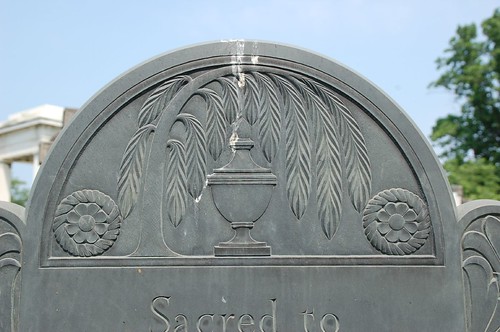
The most obvious anomaly here is the style, which is anachronistic for the 1790s. By that time, gravestones in Providence, Marblehead, and other well-connected places were moving toward lightly-inscribed urn-and-willow designs. In contrast, the Ephraim Terry stone has a deeply-carved, sensuous design and a curvy outline, indicating that it derives from older styles. This isn't surprising because Lebanon was (and is) a small, rural hamlet, not an urban center, so the aesthetic sense may have been a bit provincial. The style of the face and pointy wings indicate that this stone was carved by a member of the Manning family, possibly one of Josiah Manning's sons, Rockwell or Frederick, or a member of his workshop. For more info on the Mannings, see Allan I. Ludwig's Graven Images: New England Stonecarving and its Symbols, 1650-1815, page 409.

But the thing that interested me most was the inscription, which contains a curious misspelling of "departed" as "depated" with the "r" added in later:
This (mis)spelling can also be found on the William Pabodie stone in Little Compton, Rhode Island:
Just try saying "depated" with a short a and presto, you sound like you're from Fall River. The fact that more than one carver made the same mistake indicates that the southern New England accent was light on the "r"s, even in the eighteenth century. There's another stone in Lebanon that says that someone died in "Novemba," but I wasn't able to find it on this trip - I'll look again next time. If these gravestones are any evidence, the colonial New England accent is best preserved by modern residents of southeastern Massachusetts/northern Rhode Island.

One last interesting thing: if the carvings preserve a pronunciation, it probably means that the carvers may have been literate enough to write phonetically, and someone was literate enough to catch a spelling error.


Update:
I found another one! This example is from the Brooklyn, Connecticut cemetery next to the fair grounds. Jane Tyler "Depated" this life in 1741.

Sunday, May 18, 2008

Trumbull Burying Ground

I went home to Connecticut earlier today to catch the matinee of my sister's school play: "Thoroughly Modern Millie." The less said about that, the better.

I had a little time to waste while my parents were out squiring grandparents to and fro, so I stopped by the Trumbull Burying Ground in Lebanon, CT. This has been one of my favorite graveyards ever since I can remember, so it was a little sad to see it in such bad shape. Even in the past ten years, the monuments have degraded significantly, and I was unable to find some of the specific stones I wanted to take pictures of.

Part of the problem is that the stone used in northeastern Connecticut is of much poorer quality than that found in the Marblehead graveyards. Instead of dense slate, the local carvers used local granite full of mica or, even worse, red sandstone. The red stones are beautiful, but the material is so porous that water leaches in and then freezes, causing spalling, which is when a section of the stone flakes off. Here are some examples of pretty serious spalling:


One thing that caught my attention was that there are several stones in Lebanon that refer to men as the husband of a woman. It is common for an early American epitaph to make reference to a woman's husband, but I'm not sure whether I've ever seen it the other way around before. I'll have to keep my eyes open for that.

This one's a little hard to read, but I promise that it says, "Here lies interred the Body of MISTAR JOHN WEBSTERS, who was the loveing consort of Mrs. Elizabeth Webster . . .":
Here is another, which states that Mr. (Unreadable) Phelps was "ye husband of Mrs. Sarah Phelps." I know it's hard to read. If you click on it, the picture will get much bigger, which may help.
As you can see, these stones are in danger of eroding completely. Being buried might actually preserve them.

If you've ever seen another seventeenth- or eighteenth-century gravestone with "husband of" on it, please let me know.

Thursday, May 15, 2008

Get Off the Track

Today's happy news from California and Melissa McEwan's comment about hearing "equality coming down the tracks" reminds me of one of my favorite Civil War-era songs: "Get Off the Track." It has a driving rhythm, reminiscent of a train barreling down the track, and reinforcing the idea that progress is irresistible. I'm not sure if I agree with that as an historical philosophy, but it makes for a good song.

"Get Off the Track"
by the Hutchinson Family

Ho! the car emancipation
Rides majestic through our nation,
Bearing on its train the story,
Liberty! a nation's glory.
Roll it along! Roll it along!
Roll it along, through the nation,
Freedom's car, Emancipation.

Men of various predilections
Frightened, run in all directions,
Merchants, editors, physicians,
Lawyers, priests, and politicians,
Get out of the way! Get out of the way!
Get out of the way, every station,
Clear the track for Emancipation.

Let the ministers and churches
Leave behind sectarian lurches,
Jump on board the car of freedom,
Ere it be too late to need them.
Sound the alarm! Sound the alarm!
Sound the alarm! Pulpits thunder,
Ere too late you see your blunder.

All true friends of Emancipation,
Haste to freedom's railroad station,
Quick, into the cars get seated;
All is ready and completed.
Put on the steam! Put on the steam!
Put on the steam! all are crying,
While the liberty flags are flying.

Hear the mighty car-wheels humming,
Now, look out! the engine's coming!
Church- and statesmen hear the thunder,
Clear the track or you'll fall under.
Get off the track! Get off the track!
Get off the track! all are singing,
While the Liberty Bell is ringing.

On triumphant, see them bearing,
Through sectarian rubbish tearing;
The bell and whistle and the steaming
Startle thousands from their dreaming.
Look out for the cars! Look out for the cars!
Look out for the cars! while the bell rings,
Ere the sound your funeral knell rings.

See the people run to meet us!
At the depots, thousands greet us;
All take seats with exultation,
In the car, Emancipation.
Huzzah! Huzzah! Huzzah! Huzzah!
Huzzah! Huzzah! Emancipation
Soon will bless our happy nation!

Friday, May 9, 2008

The Humiston Children

I am generally a pretty cynical person, but there are some stories that are just so pathetic that you can't help but get drawn into the calculated, Victorian sob-fest.

Witness: The (adorable) Humiston Children.

On July 1, 1863, Sgt. Amos Humiston of the 154th New York Volunteer Infantry was killed as his regiment retreated through the streets of Gettysburg. By the time a burial detail recovered his remains after the battle, he was unrecognizable and had no identifying papers or markings. According to newspaper accounts, which are probably embellished for maximum tear-jerking, the only clue about his identity was a picture of three children that he clutched in his hand as he died.

Leslie's Illustrated Newspaper gives us this image of the scene. The vultures are an especially nice touch:
In an effort to identify the soldier, somebody had the bright idea that they should publish the photograph in newspapers because, hey, somebody's going to recognize those kids, right? And what an awesome way to let somebody know that her husband is dead.

On October 19, 1863, the Philadelphia Inquirer published (a description of) the photograph under the headline, “Whose Father Was He?” The story was reprinted in many newspapers, and Humiston’s wife, Philinda, eventually recognized her children: 4-year old Freddie, 6-year-old Alice, and 8-year-old Franklin.* The tragic story of the Humiston children became a fundraising cause throughout the North, and so much money was donated that the Humistons built a house for war orphans in Gettysburg after the war. The Humiston photograph was reproduced on cards for sale at Sanitary Commission fairs and adorned the covers of sheet music.

Today, there is a monument to Humiston and his family near the spot where his body was found. I used this story in my monument paper as part of a discussion of how recent monuments at Gettysburg are trying to transform the battlefield to divert visitor's attention to the human tragedy rather than the fighting or the causes of the war. In the last 15 years, we have seen new monuments such as the "Friend-to-Friend" Masonic memorial and the Maryland state monument, both of which depict suffering, unarmed men helping their supposed enemies, as well as monuments such as the Humiston and Elizabeth Thorn memorials. All of these shift the conversation to mutual suffering, almost as if the battle were a natural disaster or some other sort of inevitable tragedy that Americans endured through no fault of their own. I'm not saying that we shouldn't honor Elizabeth Thorn or tell the story of Amos Humiston, but the trajectory of the memorial landscape does not get to the heart of the issues of freedom and equality that brought people to Gettysburg in the first place.

If you're interested in a straightforward account of the Humiston story without all the handwringing about memory and erasure, check out Mark Dunkelman's Gettysburg's Unknown Soldier: The Life, Death, and Celebrity of Amos Humiston (1999).

*Update (3/31/09): It seems that my initial discription was a little bit off — the original newspaper accounts apparently carried descriptions of the photo, but not reproductions of it. Philinda Humiston recognized a description of the photo and sent away for a copy to make certain that the dead man was her husband.

Thursday, May 8, 2008

To Canaan!


Today, I came across the most pompous Civil War song I've ever found, which is saying a lot. This song appeared in the Boston Evening Transcript on August 2, 1862.

I'm always fascinated by New Englanders' identification with the Old Testament Israelites, and this is evidence that it did not end in the 17th century. As much as we debate republicanism vs. liberalism, the fact is that many people in 18th and even 19th-century America placed themselves in a Biblical landscape.

"To Canaan" uses the Old Testament language fluently, but some of the implications are fairly disturbing if you carry the analogy far enough. For one thing, the song positions the Union armies as Jews during the Exodus, on their way to Canaan after being released from slavery in Egypt. What will they do when they get to Canaan? Well, in the Bible, they slaughter every man, woman, child, and animal they can find. That can't have been comforting to Southerners.

My favorite line is this pronouncement on the American flag:
"What God has woven in his loom let no man rend in twain!"

To Canaan!
(A Song of the Six Hundred Thousand)

Where are you going soldiers, with banner, gun and sword?
We're marching South to Canaan to battle for the Lord!
What captain leads your armies along the rebel coasts?
The Mighty One of Israel, His name is Lord of Hosts!
To Canaan, to Canaan, the Lord has led us forth,
To blow before the heathen walls the trumpets of the North.

What flag is this you carry along the sea and shore?
The same our grandsires lifted up, the same our fathers bore!
In many a battle's tempest it shed the crimson rain —
What God has woven in his loom, let no man rend in twain!
To Canaan, to Canaan, the Lord has led us forth,
To plant upon the rebel towers the banners of the North!

What troop is this that follows, all armed with picks and spades?
These are the swarthy bondsmen, the iron-skin brigades!
They'll pile up Freedom's breastwork, they'll scoop out rebels' graves;
Who then will be their owner and march them off for slaves?
To Canaan, to Canaan, the Lord has led us forth,
To strike upon the captive's chains the hammers of the North.

What song is this you're singing? The same that Israel sung
When Moses led the mighty choir, and Miriam's timbrels rung!
To Canaan! To Canaan! The priests and maidens cried;
To Canaan! To Canaan! The people's voice replied.
To Canaan, to Canaan, the Lord has led us forth,
To thunder through its adder-dens the anthems of the North.

When Canaan's hosts are scattered and all her walls lie flat,
What follows next in order? The Lord will see to that!
We'll break the tyrant's sceptre, we'll build the people's throne,
When half the world is Freedom's, then all the world's our own!
To Canaan, to Canaan, the Lord has led us forth,
To sweep the rebel threshing-floors, a whirlwind from the North.

Wednesday, May 7, 2008

Birth of a Notion

Via Civil War Memory, I came across this wonderful cartoon: "Town of Dobson" by Storm Bear. It's funny, it's poignant, and each strip is accompanied by a lengthy historical background section. It's like heaven for end-of-semester procrastinators.


Tuesday, May 6, 2008

Army Emblem

Apparently, I was wrong to assume that the government would be unwilling to display the overtly phallic image of the liberty pole and cap. The amazing image I posted yesterday can be seen (in modified form) on the current emblem of the United States Army. Granted, it's a little less explicit and the shaft is not being "supported" by a dozen tiny hands, but it's still a phallus. The slogan, "Hanc Tuemur, Hac Nitimur" is also preserved in the form of a snake saying, "This We'll Defend." Why a snake? I suppose it's a "Don't Tread on Me" or "Join, or Die" reference, but I still find it interesting to find a talking snake on any of our government's official emblems.

I guess this iteration of the symbol isn't so overtly phallic, and it might be difficult to argue that it is without seeing its antecedent. But knowing where this image originated, I feel pretty comfortable pointing out that it is, indeed, a penis.

Monday, May 5, 2008

Happy Birthday, Pete!

It's my husband's birthday.

I bought him flowers, but somebody ate them.


Journal of the Proceedings of Congress, 1774

When the Continental Congress met in Philadelphia in 1774, secretary Charles Thompson kept daily records of the proceedings. These records were eventually published as the Journal of the Proceedings of Congress. Here is the Journal's emblem:

In his 2005 WMQ article, "Being Alone in the Age of Social Contract," UChicago professor Eric Slauter descibes how the "erect pillar with liberty cap" is "held steady by twelve arms." Apparently, the inscription, "Hanc Tuemur, Hac Nitimur" means something along the lines of "this we guard; for this we strive." I see.

Slauter acknowledges that this image is suggestive of the relationship between masculinity and the founders' idea of liberty, but he fails to mention how hilarious it is.

I wonder why this image isn't on U.S. money, stamps, or government seals. Maybe I'll write to some representatives and see if we can't get them to change the emblem on the Congressional Record letterhead just for old times' sake. After all, it's what the founders wanted.


See the LOC for more.

Friday, May 2, 2008

The Famous Lincon-Douglas[s] Debates


Bwah ha ha ha ha! What do I think, indeed.

This reminds me of my all-time favorite book, Barron's Painless American History by Curt Lader, a study guide for middle school students. Any teacher who ever wondered where his/her students picked up their strange ideas about US history can send Mr. Lader a thank-you note. The student reader will learn the following from this book:
  • "A blow was struck for freedom of the press in 1734 when John Peter Zenger was defended by a young lawyer named Alexander Hamilton when Zenger was accused of libel — which is making false statements — against the governor of New York." Of course, Zenger's lawyer was Andrew Hamilton. Alexander Hamilton wasn't born until 1755 (though he might have meant Dr. Alexander Hamilton, who still lived in Scotland in 1734). Also, that's not what libel means.
  • "The issue of slavery caused much controversy even in the early days of colonization. Northerners felt that slavery was wrong, while in the South, plantation owners saw the need for what they called 'the peculiar institution.'" Yep, all colonial-era Northerners thought slavery was wrong.
  • "Before we analyze the battle, look at the first verse of the famous poem, 'The Midnight Ride of Paul Revere.' Imagine what the response of the colonists was when they got the warning, 'The British are coming, the British are coming!" J.L. Bell has already said it all.
  • "In 1864 Lincoln fired General McClellan after the Union loss at Antietam." Wow, if it took Lincoln two years to act after the battle, no wonder the Union was having trouble.
  • "An angry Confederate soldier, John Wilkes Booth, shot the president as he was sitting with Mrs. Lincoln in the presidential box." Soldier?
Most of that is piddly stuff, but this isn't:
  • "[John] Brown's own words as a slave illustrate his intense hatred of the institution . . . When you look at the diary entry, you will see the agony that Brown went through as a slave. It is not surprising that when he escaped, he decided to lead the attack. You must take this suffering into account in deciding what you would have done if you were John Brown."
Ha ha ha ha ha. The "diary entry" Lader refers to is an excerpt from an 1855 slave narrative called Slave Life in Georgia, which was dictated by a fugitive slave named John Brown who escaped and moved to England in 1850. Shockingly, there was more than one person in the English-speaking world named John Brown.

I'm sure I have made embarrassing public errors in the past and I will continue to do so in the future. That doesn't mean I don't enjoy laughing at other people's.